


Shopping Cart
Remove All Your shopping cart is currently empty

Synonyms:
| Pack Size | Price | USA Stock | Global Stock | Quantity |
|---|---|---|---|---|
| 10 mg | Inquiry | 10-14 weeks | 10-14 weeks | |
| 50 mg | Inquiry | 10-14 weeks | 10-14 weeks |
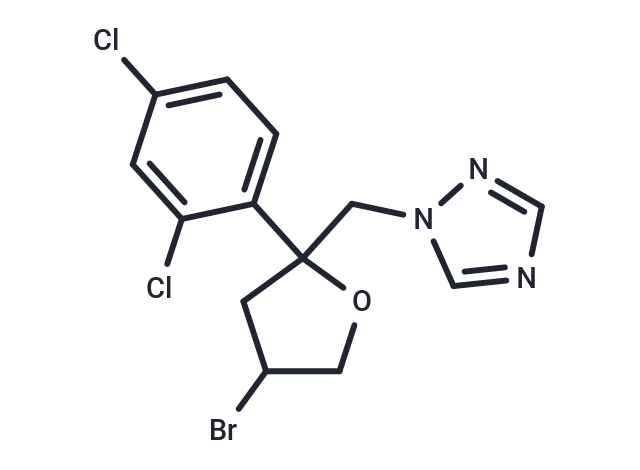
| Description | Bromuconazole is a triazole fungicide with oral efficacy and blood-brain barrier permeability. It offers protection to crops against various fungal contaminations. Bromuconazole is cytotoxic to multiple cancer cells, inducing G0/G1 phase cell cycle arrest and inhibiting DNA synthesis. It disrupts cytoskeletal structures, causes genotoxic damage, induces apoptosis, and leads to mitochondrial membrane depolarization. Bromuconazole activates caspase-3, triggers the excessive production of ROS, p53, and Bax, promotes lipid peroxidation, and increases the activity of SOD and CAT while downregulating Bcl-2. By upregulating p-ERK1/2 and p-JNK, it disrupts the MAPK signaling pathway, impairing the endometrial and trophoblast cell stress responses, which hinders implantation. Bromuconazole is used in research related to glioma, colon cancer, reproductive damage (implantation dysfunction), and cardiac dysfunction. |
| In vitro | Bromuconazole exhibits concentration-dependent cytotoxicity in F98 and HCT116 cells, with IC50 values of 60 and 180 μM, respectively, when applied at concentrations of 0-500 μM for 24 hours. At 0-180 μM between 6-24 hours, it induces G0/G1 phase cell cycle arrest, inhibits DNA synthesis, and causes cytoskeletal disruption, genotoxic damage (DNA fragmentation and nuclear condensation), apoptotic cell death, and mitochondrial membrane depolarization. In F98 rat glioma cells, bromuconazole (15-60 μM; 24 h) upregulates p53 and Bax mRNA in a concentration-dependent manner, downregulates Bcl-2 mRNA, increases the Bax/Bcl-2 ratio, and activates caspase-3. In HCT116 cells, within 45-180 μM for 24 hours, it leads to caspase-3 activation, excessive ROS generation, lipid peroxidation, and increased SOD and CAT activity. Bromuconazole also damages cell viability of HTR-8/SVneo and T HESCs, with 48-hour LC50 values of 28.05 mg/L and 33.41 mg/L, respectively, at concentrations of 0-50 mg/L. It disrupts 3D spheroid formation and self-assembly, induces apoptosis through dysregulation of apoptosis-related gene expression, increases the BAX/BCL-XL protein ratio, induces G2/M phase cell cycle arrest by downregulating cell cycle genes and disrupts mitochondrial function by reducing membrane potential and downregulating mitochondria-related gene expression at concentrations of 30 mg/L for 24-48 hours. Bromuconazole at 30 mg/L induces ROS accumulation and ER stress in HTR-8/SVneo and THESCs by downregulating SOD1 and upregulating ER stress-related factors within 30 minutes to 24 hours. It perturbs the MAPK signaling pathway by upregulating p-ERK1/2 and p-JNK in HTR-8/SVneo and T HESCs in 15 minutes. Inflammation is induced through dysregulated mRNA expression of pro-inflammatory and anti-inflammatory cytokines in the same cells for 24 hours, while it also inhibits their migration at 30 mg/L over a 24-48 hour period. In H9C2 rat cardiomyocytes, bromuconazole (10-250 μM; 24 h) causes cytotoxicity, disrupts energy metabolism, ion balance, and myosin synthesis-related gene expression, and upregulates LEF1 protein expression. |
| In vivo | Bromuconazole, administered orally at 13.8-32.8 mg/kg/day or topically at 84-200 mg/kg/day for 90 days, induces dose-dependent hepatotoxicity in male albino rats, with oral exposure being more toxic than topical application. This toxicity is characterized by increased liver enzyme levels, oxidative stress, increased liver weight, necrotic lesions in histopathology, upregulation of liver PXR, CYP3A1 expression and activity, and downregulation of hepatic CAR and CYP2B1 expression. Furthermore, exposure to Bromuconazole at 50 ng/L-7.5 mg/L via i.g. once daily for seven consecutive days induces cardiotoxicity in adult male AB strain zebrafish by disrupting cardiac energy metabolism, altering ion balance and myosin synthesis gene expression, and abnormally activating LEF1. |
| Molecular Weight | 377.06 |
| Formula | C13H12BrCl2N3O |
| Cas No. | 116255-48-2 |
| Smiles | ClC1=CC=C(C(Cl)=C1)C2(OCC(Br)C2)CN3N=CN=C3 |
| Storage | Powder: -20°C for 3 years | In solvent: -80°C for 1 year Shipping with blue ice/Shipping at ambient temperature. |
 For example, if the intended dosage is 10 mg/kg for animals weighing 20 g , with a dosing volume of 100 μL per animal, and a total of 10 animals are to be administered, using a formulation of
  10% DMSO+ 40% PEG300+ 5% Tween 80+ 45% Saline/PBS/ddH2O , the resulting working solution concentration would be 2 mg/mL.
Dissolve 2 mg of the compound in 100 μL DMSO to obtain a stock solution at a concentration of 20 mg/mL . If the required concentration exceeds the compound's known solubility, please contact us for technical support before proceeding.
1) Add 100 μL of the DMSO stock solution to 400 µL PEG300 and mix thoroughly until the solution becomes clear.
2) Add 50 µL Tween 80 and mix well until fully clarified.
3) Add 450 µL Saline,PBS or ddH2O and mix thoroughly until a homogeneous solution is obtained.
| Size | Quantity | Unit Price | Amount | Operation |
|---|
 Feedback
 Hello! How can I help you today?
Copyright © 2015-2026 TargetMol Chemicals Inc. All Rights Reserved.
