


Shopping Cart
Remove All Your shopping cart is currently empty

Synonyms: E7010 hydrochloride
| Pack Size | Price | USA Stock | Global Stock | Quantity |
|---|---|---|---|---|
| 25 mg | $1,520 | 4-6 weeks | 4-6 weeks | |
| 50 mg | $1,980 | 4-6 weeks | 4-6 weeks | |
| 100 mg | $2,500 | 4-6 weeks | 4-6 weeks |
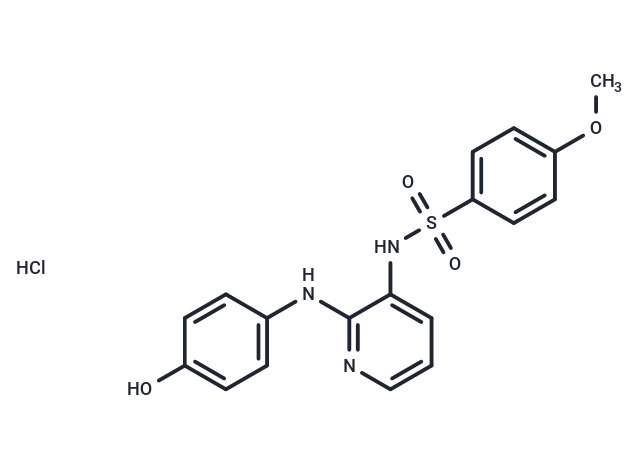
| Description | ABT-751 (E7010) hydrochloride is a novel sulfonyl anti-mitotic compound and a tubulin binder with high oral bioavailability. This agent binds to the colchicine site on β-tubulin, inhibiting the polymerization of tubulin which results in cell cycle arrest at the G2/M phase and induces apoptosis, effectively preventing cell division. Additionally, ABT-751 (E7010) hydrochloride induces autophagy by inhibiting the AKT/MTOR signaling pathway. It exhibits significant inhibitory effects against various types of cancer cells, including lung, stomach, colon, and breast cancer. |
| In vitro | ABT-751 hydrochloride (2 μM; 4, 8, 24h) demonstrates multiple effects on Hep-3B cells, a hepatocellular carcinoma-derived line, including disruption of mitosis, mitochondrial membrane potential, induction of ROS production, and DNA damage. Additionally, in these cells, ABT-751 hydrochloride interferes with DNA integrity, inhibits cell proliferation, and induces G2/M cell cycle arrest. Furthermore, this compound promotes autophagy in Hep-3B cells lacking TP53 through inhibition of the AKT/MTOR signaling pathway, and induces apoptosis via caspase-dependent, extrinsic, and intrinsic pathways. The expression of exogenous TP53 gene further enhances the autophagy and apoptosis induced by ABT-751 hydrochloride in these cells. |
| In vivo | ABT-751 hydrochloride administered at a dosage of 100 mg/kg/day orally with a schedule of 5 days on followed by 5 days off, repeated twice over a period of 21 days, has demonstrated significant inhibitory effects in a neuroblastoma model, and has significantly reduced or eliminated tumor volumes in rhabdomyosarcoma and renal cell carcinoma models. Furthermore, ABT-751 enhances the effects of Vincristine and Paclitaxel, showing a synergistic effect. In the models of prostate, non-small cell lung, and breast tumor xenografts in mice, ABT-751 hydrochloride (100 mg/kg/day, 5 days on, 5 days off x2) also exhibits a synergistic action with Docetaxel, improving the suppression of tumor growth. |
| Synonyms | E7010 hydrochloride |
| Molecular Weight | 407.87 |
| Formula | C18H18ClN3O4S |
| Cas No. | 141450-48-8 |
| Smiles | Cl.O=S(=O)(NC1=CC=CN=C1NC2=CC=C(O)C=C2)C3=CC=C(OC)C=C3 |
| Storage | Powder: -20°C for 3 years | In solvent: -80°C for 1 year Shipping with blue ice/Shipping at ambient temperature. |
 For example, if the intended dosage is 10 mg/kg for animals weighing 20 g , with a dosing volume of 100 μL per animal, and a total of 10 animals are to be administered, using a formulation of
  10% DMSO+ 40% PEG300+ 5% Tween 80+ 45% Saline/PBS/ddH2O , the resulting working solution concentration would be 2 mg/mL.
Dissolve 2 mg of the compound in 100 μL DMSO to obtain a stock solution at a concentration of 20 mg/mL . If the required concentration exceeds the compound's known solubility, please contact us for technical support before proceeding.
1) Add 100 μL of the DMSO stock solution to 400 µL PEG300 and mix thoroughly until the solution becomes clear.
2) Add 50 µL Tween 80 and mix well until fully clarified.
3) Add 450 µL Saline,PBS or ddH2O and mix thoroughly until a homogeneous solution is obtained.
| Size | Quantity | Unit Price | Amount | Operation |
|---|
 Feedback
 Hello! How can I help you today?
Copyright © 2015-2026 TargetMol Chemicals Inc. All Rights Reserved.
