


Shopping Cart
Remove All Your shopping cart is currently empty
Synonyms: transforming growth factor, β1, transforming growth factor, beta 1, TGF β1
| Pack Size | Price | USA Stock | Global Stock | Quantity |
|---|---|---|---|---|
| 5 µg | $93 | In Stock | - | |
| 10 µg | $150 | - | In Stock | |
| 20 µg | $245 | - | In Stock | |
| 50 µg | $465 | - | In Stock | |
| 100 µg | $790 | - | In Stock | |
| 200 µg | Inquiry | 7-10 days | 7-10 days | |
| 500 µg | Inquiry | 7-10 days | 7-10 days |
| Bioactivity | Measured by its ability to inhibit cell proliferation of Mv-1-lu mink lung epithelial cells. The ED50 for this effect is 0.2-0.8 ng/mL. |
| Description | TGF beta 1 Protein, Rat/Mouse, Recombinant is expressed in HEK293 mammalian cells. The predicted molecular weight is 12.8 kDa. |
| Species | Mouse,Rat |
| Expression System | HEK293 Cells |
| Tag | Tag Free |
| Construction | A DNA sequence encoding the mouse / rat TGFB1 (Ala279-Ser390) was expressed. Rat and Mouse mature TGFB1 sequences are identical. Predicted N terminal: Ala 279 |
| Protein Purity | > 90 % as determined by SDS-PAGE 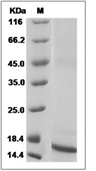 |
| Endotoxin | < 1.0 EU/μg of the protein as determined by the LAL method. |
| Formulation | Lyophilized from a solution filtered through a 0.22 μm filter, containing PBS, pH 7.4. Typically, a mixture containing 5% to 8% trehalose, mannitol, and 0.01% Tween 80 is incorporated as a protective agent before lyophilization. |
| Reconstitution | Reconstituted with sterile deionized water to 0.1 mg/mL. Reconstitution conditions may vary depending on the lot. |
| Synonyms | transforming growth factor, β1, transforming growth factor, beta 1, TGF β1 |
| Research Background | TGF-beta 1 is a member of the transforming growth factor beta (TGF-beta) family. The transforming growth factor-beta family of polypeptides are involved in the regulation of cellular processes, including cell division, differentiation, motility, adhesion and death. TGF-beta 1 positively and negatively regulates many other growth factors. It inhibits the secretion and activity of many other cytokines including interferon-γ, tumor necrosis factor-alpha and various interleukins. It can also decrease the expression levels of cytokine receptors. Meanwhile, TGF-beta 1 also increases the expression of certain cytokines in T cells and promotes their proliferation, particularly if the cells are immature. TGF-beta 1 also inhibits proliferation and stimulates apoptosis of B cells, and plays a role in controlling the expression of antibody, transferrin and MHC class II proteins on immature and mature B cells. As for myeloid cells, TGF-beta 1can inhibit their proliferation and prevent their production of reactive oxygen and nitrogen intermediates. However, as with other cell types, TGF-beta 1 also has the opposite effect on cells of myeloid origin. TGF-beta 1 is a multifunctional protein that controls proliferation, differentiation and other functions in many cell types. It plays an important role in bone remodeling as it is a potent stimulator of osteoblastic bone formation, causing chemotaxis, proliferation and differentiation in committed osteoblasts. Once cells lose their sensitivity to TGF-beta1-mediated growth inhibition, autocrine TGF-beta signaling can promote tumorigenesis. Elevated levels of TGF-beta1 are often observed in advanced carcinomas, and have been correlated with increased tumor invasiveness and disease progression.Cancer ImmunotherapyImmune CheckpointImmunotherapyTargeted Therapy |
| Molecular Weight | 12.8 kDa (predicted) |
| Shipping | In general, lyophilized powders are shipped with blue ice, while solutions are shipped with dry ice. |
| Storage | It is recommended to store recombinant proteins at -20°C to -80°C for future use. Lyophilized powders can be stably stored for over 12 months, while liquid products can be stored for 6-12 months at -80°C. For reconstituted protein solutions, the solution can be stored at -20°C to -80°C for at least 3 months. Please avoid multiple freeze-thaw cycles and store products in aliquots. |
| Size | Quantity | Unit Price | Amount | Operation |
|---|
 Feedback
 Hello! How can I help you today?
Copyright © 2015-2026 TargetMol Chemicals Inc. All Rights Reserved.
