


Shopping Cart
Remove All Your shopping cart is currently empty
Synonyms: RON, PTK8, macrophage stimulating 1 receptor, CDw136, CD136
| Pack Size | Price | USA Stock | Global Stock | Quantity |
|---|---|---|---|---|
| 5 µg | $48 | - | In Stock | |
| 10 µg | $75 | - | In Stock | |
| 20 µg | $118 | - | In Stock | |
| 50 µg | $229 | - | In Stock | |
| 100 µg | $386 | - | In Stock | |
| 200 µg | $682 | 7-10 days | 7-10 days | |
| 500 µg | $1,430 | 7-10 days | 7-10 days |
| Bioactivity | Activity testing is in progress. It is theoretically active, but we cannot guarantee it. If you require protein activity, we recommend choosing the eukaryotic expression version first. |
| Description | The tyrosine kinase receptor, macrophage-stimulating 1 receptor (MST1R), a c-met-related tyrosine kinase, also known as the Ron receptor or CD136, controls cell survival and motility programs related to invasive growth. As the tyrosine kinase receptor is comprised of an extracellular domain, MST1R protein contains the ligand-binding pocket and an intracellular region where the kinase domain is located. MST1R signaling may be involved in the regulation of macrophage and T-lymphocyte activation in vivo during injury. This assessment of gene expression indicates the importance of genetic factors in contributing to lung injury and points to strategies for intervention in the progression of inflammatory diseases. It had been shown that MST1R/CD136 plays a critical role in Ni-induced lung injury in mice. The overexpression of MSP, MT-SP1, and MST1R was a strong independent indicator of both metastasis and death in human breast cancer patients and significantly increased the accuracy of an existing gene expression signature for poor prognosis. Stimulation of MST1R leads to its transphosphorylation and the ultimate activation of numerous intracellular signaling pathways, such as the classical mitogen-activated protein kinase pathway, the phosphatidylinositol (PI)3-kinase pathway, and the JNK pathway. |
| Species | Human |
| Expression System | HEK293 Cells |
| Tag | C-His |
| Accession Number | Q04912 |
| Construction | A DNA sequence encoding the amino acid sequence (Met 1-Leu 571) of human CD136 (Q04912) extracellular domain was fused with a polyhistidine tag at the C-terminus. Predicted N terminal: Glu 25 & Gly 310 |
| Protein Purity | > 98 % as determined by SDS-PAGE 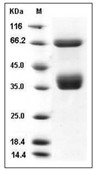 |
| Endotoxin | < 1.0 EU/μg of the protein as determined by the LAL method. |
| Formulation | Lyophilized from a solution filtered through a 0.22 μm filter, containing PBS, pH 7.4. Typically, a mixture containing 5% to 8% trehalose, mannitol, and 0.01% Tween 80 is incorporated as a protective agent before lyophilization. |
| Reconstitution | Reconstituted with sterile deionized water to 0.25 mg/mL. Reconstitution conditions may vary depending on the lot. |
| Synonyms | RON, PTK8, macrophage stimulating 1 receptor, CDw136, CD136 |
| Research Background | The tyrosine kinase receptor, macrophage-stimulating 1 receptor (MST1R), a c-met-related tyrosine kinase, also known as the Ron receptor or CD136, controls cell survival and motility programs related to invasive growth. As the tyrosine kinase receptor is comprised of an extracellular domain, MST1R protein contains the ligand-binding pocket and an intracellular region where the kinase domain is located. MST1R signaling may be involved in the regulation of macrophage and T-lymphocyte activation in vivo during injury. This assessment of gene expression indicates the importance of genetic factors in contributing to lung injury and points to strategies for intervention in the progression of inflammatory diseases. It had been shown that MST1R/CD136 plays a critical role in Ni-induced lung injury in mice. The overexpression of MSP, MT-SP1, and MST1R was a strong independent indicator of both metastasis and death in human breast cancer patients and significantly increased the accuracy of an existing gene expression signature for poor prognosis. Stimulation of MST1R leads to its transphosphorylation and the ultimate activation of numerous intracellular signaling pathways, such as the classical mitogen-activated protein kinase pathway, the phosphatidylinositol (PI)3-kinase pathway, and the JNK pathway. |
| Molecular Weight | 60 kDa (predicted); 70 kDa and 37 kDa (reducing condition, due to glycosylation) |
| Shipping | In general, lyophilized powders are shipped with blue ice, while solutions are shipped with dry ice. |
| Storage | It is recommended to store recombinant proteins at -20°C to -80°C for future use. Lyophilized powders can be stably stored for over 12 months, while liquid products can be stored for 6-12 months at -80°C. For reconstituted protein solutions, the solution can be stored at -20°C to -80°C for at least 3 months. Please avoid multiple freeze-thaw cycles and store products in aliquots. |
| Size | Quantity | Unit Price | Amount | Operation |
|---|
 Feedback
 Hello! How can I help you today?
Copyright © 2015-2026 TargetMol Chemicals Inc. All Rights Reserved.
