


Shopping Cart
Remove All Your shopping cart is currently empty

Plasmodium falciparum lactate dehydrogenase (PfLDH) is a key enzyme for energy generation of malarial parasites and is considered to be a potential antimalarial target. The ability of PfLDH- or PfIDEh-based immuno-PCR assays to detect <1 parasite/microL suggests that improvements of bound antibody sensor technology may greatly increase the sensitivity of malaria rapid diagnostic tests. The PfLDH test could be used to detect failures and, therefore, to assess anti-malarial efficacy.
| Pack Size | Price | USA Stock | Global Stock | Quantity |
|---|---|---|---|---|
| 5 μg | $55 | - | In Stock | |
| 10 μg | $86 | - | In Stock | |
| 20 μg | $139 | - | In Stock | |
| 50 μg | $269 | - | In Stock | |
| 100 μg | $451 | - | In Stock | |
| 200 μg | $798 | 7-10 days | 7-10 days | |
| 500 μg | $1,690 | 7-10 days | 7-10 days |
| Biological Activity | Measured by its ability to reduce pyruvate to lactate. The specific activity is >50,000 pmoles/min/μg. |
| Description | Plasmodium falciparum lactate dehydrogenase (PfLDH) is a key enzyme for energy generation of malarial parasites and is considered to be a potential antimalarial target. The ability of PfLDH- or PfIDEh-based immuno-PCR assays to detect <1 parasite/microL suggests that improvements of bound antibody sensor technology may greatly increase the sensitivity of malaria rapid diagnostic tests. The PfLDH test could be used to detect failures and, therefore, to assess anti-malarial efficacy. |
| Species | P. falciparum |
| Expression System | E. coli |
| Tag | C-His |
| Accession Number | Q76NM3 |
| Synonyms | PfLDH,L-lactate dehydrogenase |
| Construction | A DNA sequence encoding the PfLDH (XP_001349989.1) (Met1-Ala316) was expressed with a polyhistidine tag at the C-terminus. Predicted N terminal: Met |
| Protein Purity | > 95 % as determined by SDS-PAGE 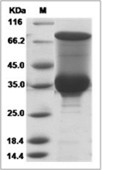 |
| Molecular Weight | 34.9 kDa (predicted) |
| Endotoxin | Please contact us for more information. |
| Formulation | Lyophilized from a solution filtered through a 0.22 μm filter, containing PBS, pH 7.4. Typically, a mixture containing 5% to 8% trehalose, mannitol, and 0.01% Tween 80 is incorporated as a protective agent before lyophilization. |
| Reconstitution | Reconstituted with sterile deionized water to 0.15 mg/mL. Reconstitution conditions may vary depending on the lot. |
| Stability & Storage | It is recommended to store recombinant proteins at -20°C to -80°C for future use. Lyophilized powders can be stably stored for over 12 months, while liquid products can be stored for 6-12 months at -80°C. For reconstituted protein solutions, the solution can be stored at -20°C to -80°C for at least 3 months. Please avoid multiple freeze-thaw cycles and store products in aliquots. |
| Shipping | In general, lyophilized powders are shipped with blue ice, while solutions are shipped with dry ice. |
| Research Background | Plasmodium falciparum lactate dehydrogenase (PfLDH) is a key enzyme for energy generation of malarial parasites and is considered to be a potential antimalarial target. The ability of PfLDH- or PfIDEh-based immuno-PCR assays to detect <1 parasite/microL suggests that improvements of bound antibody sensor technology may greatly increase the sensitivity of malaria rapid diagnostic tests. The PfLDH test could be used to detect failures and, therefore, to assess anti-malarial efficacy. |
| Size | Quantity | Unit Price | Amount | Operation |
|---|
 Feedback
 Hello! How can I help you today?
Copyright © 2015-2026 TargetMol Chemicals Inc. All Rights Reserved.