


Shopping Cart
Remove All Your shopping cart is currently empty
Synonyms: peptidyl arginine deiminase, type IV, PDI5, PDI4, PADI5, PAD4, PAD
| Pack Size | Price | USA Stock | Global Stock | Quantity |
|---|---|---|---|---|
| 5 µg | $86 | - | In Stock | |
| 10 µg | $139 | - | In Stock | |
| 20 µg | $229 | - | In Stock | |
| 50 µg | $451 | - | In Stock | |
| 100 µg | $771 | 7-10 days | 7-10 days | |
| 200 µg | $1,310 | 7-10 days | 7-10 days | |
| 500 µg | $2,660 | 7-10 days | 7-10 days |
| Bioactivity | Activity testing is in progress. It is theoretically active, but we cannot guarantee it. If you require protein activity, we recommend choosing the eukaryotic expression version first. |
| Description | Protein-arginine deiminase type-4, also known as HL-6 PAD, Peptidylarginine deiminase IV, Protein-arginine deiminase type I V and PADI4, is a cytoplasm and nucleus protein that belongs to the protein arginine deiminase family. PADI4 is expressed in CD34+stem cells in normal tissues, and many more CD34+ cells expressing PADI4 are present in tumour tissues. PADI4 post-translationally converts peptidylarginine to citrulline, a process called citrullination. Studies have demonstrated the high expression of PADI4 in various malignant tumor tissues. PADI4 is also expressed at high levels in the blood of patients with some malignant tumors. Citrullination of histone, cytokeratin, antithrombin and fibronectin have been confirmed to be involved in abnormal apoptosis, high coagulation, and disordered cell proliferation and differentiation, all of which are main features of malignant tumors. PADI4 may play an important role in tumorigenesis. Genetic variations in PADI4 are a cause of susceptibility to rheumatoid arthritis (RA). It is a systemic inflammatory disease with autoimmune features and a complex genetic component. It primarily affects the joints and is characterized by inflammatory changes in the synovial membranes and articular structures, widespread fibrinoid degeneration of the collagen fibers in mesenchymal tissues, and by atrophy and rarefaction of bony structures. |
| Species | Human |
| Expression System | Baculovirus Insect Cells |
| Tag | N-His |
| Accession Number | Q9UM07 |
| Construction | A DNA sequence encoding the human PADI4 (Q9UM07) (Met1-Pro663) was expressed with a polyhistidine tag at the N-terminus. Predicted N terminal: Met |
| Protein Purity | > 90 % as determined by SDS-PAGE. 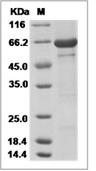 |
| Endotoxin | < 1.0 EU/μg of the protein as determined by the LAL method. |
| Formulation | Lyophilized from a solution filtered through a 0.22 μm filter, containing 20 mM Tris, 500 mM NaCl, 10% glycerol, pH 7.4. Typically, a mixture containing 5% to 8% trehalose, mannitol, and 0.01% Tween 80 is incorporated as a protective agent before lyophilization. |
| Reconstitution | Reconstituted with sterile deionized water to 0.2 mg/mL. Reconstitution conditions may vary depending on the lot. |
| Synonyms | peptidyl arginine deiminase, type IV, PDI5, PDI4, PADI5, PAD4, PAD |
| Research Background | Protein-arginine deiminase type-4, also known as HL-6 PAD, Peptidylarginine deiminase IV, Protein-arginine deiminase type I V and PADI4, is a cytoplasm and nucleus protein that belongs to the protein arginine deiminase family. PADI4 is expressed in CD34+stem cells in normal tissues, and many more CD34+ cells expressing PADI4 are present in tumour tissues. PADI4 post-translationally converts peptidylarginine to citrulline, a process called citrullination. Studies have demonstrated the high expression of PADI4 in various malignant tumor tissues. PADI4 is also expressed at high levels in the blood of patients with some malignant tumors. Citrullination of histone, cytokeratin, antithrombin and fibronectin have been confirmed to be involved in abnormal apoptosis, high coagulation, and disordered cell proliferation and differentiation, all of which are main features of malignant tumors. PADI4 may play an important role in tumorigenesis. Genetic variations in PADI4 are a cause of susceptibility to rheumatoid arthritis (RA). It is a systemic inflammatory disease with autoimmune features and a complex genetic component. It primarily affects the joints and is characterized by inflammatory changes in the synovial membranes and articular structures, widespread fibrinoid degeneration of the collagen fibers in mesenchymal tissues, and by atrophy and rarefaction of bony structures. |
| Molecular Weight | 76.3 kDa (predicted) |
| Shipping | In general, lyophilized powders are shipped with blue ice, while solutions are shipped with dry ice. |
| Storage | It is recommended to store recombinant proteins at -20°C to -80°C for future use. Lyophilized powders can be stably stored for over 12 months, while liquid products can be stored for 6-12 months at -80°C. For reconstituted protein solutions, the solution can be stored at -20°C to -80°C for at least 3 months. Please avoid multiple freeze-thaw cycles and store products in aliquots. |
| Size | Quantity | Unit Price | Amount | Operation |
|---|
 Feedback
 Hello! How can I help you today?
Copyright © 2015-2026 TargetMol Chemicals Inc. All Rights Reserved.
