


Shopping Cart
Remove All Your shopping cart is currently empty

Synonyms: Anti-His Immunoprecipitation Kit
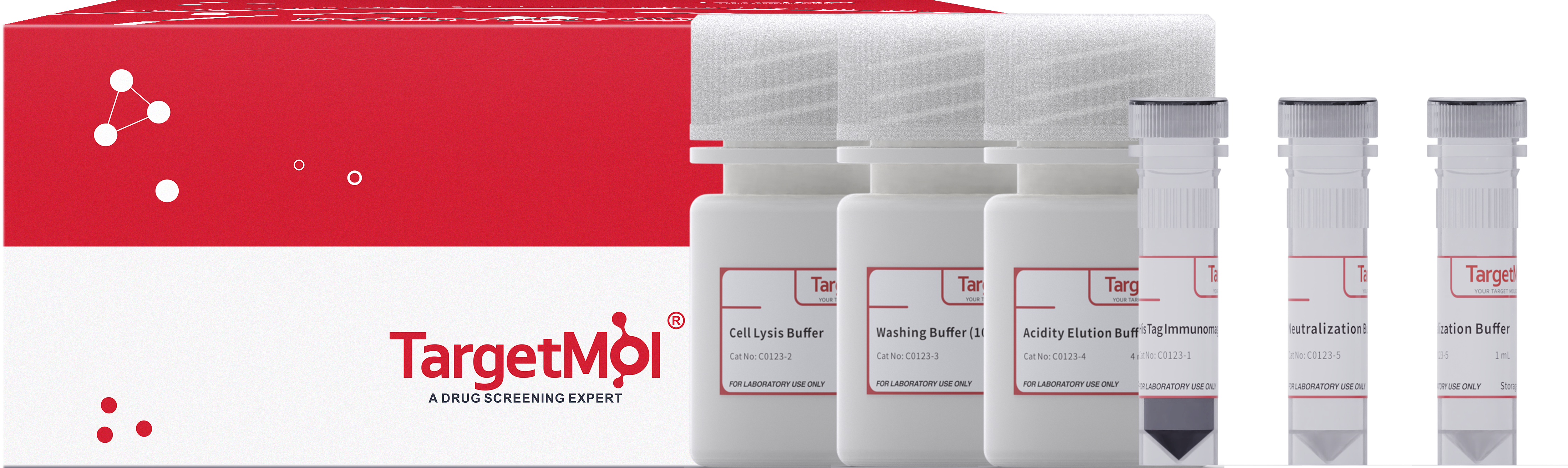
| Pack Size | Price | USA Stock | Global Stock | Quantity |
|---|---|---|---|---|
| 40 T | $298 | - | In Stock |
 Related Products Product Components
| Catalog No. | Product Name | Package Size |
|---|---|---|
| C0123B | His Tag Immunomagnetic Beads | 1 mL |
| C0124 | Immunomagnetic Beads Cell Lysis Buffer | 20 mL |
| C0125 | Immunomagnetic Beads Washing Buffer (10×) | 20 mL |
| C0126 | Immunomagnetic Beads Elution Buffer | 4 mL |
| C0127 | Immunomagnetic Beads Neutralization Buffer | 2 mL |
| His Tag Immunomagnetic Beads | Specification |
|---|---|
| Matrix | Silica-based magnetic beads |
| Particle Size | 200 nm |
| Binding Capacity | ≥ 0.5 mg His-tagged protein/mL beads |
| Bead Concentration | 10 mg/mL |
| Ligand | Mouse-derived anti-His monoclonal antibody |
| Recommended Applications | IP, Co-IP |
Product Features• Low non-specific binding
• Time saving and efficient usage
• Convenient and simple operation
• Assay consistency
Instruction1. Preparation of Cell Lysates
Use Cell Lysis Buffer to process cell samples. Prepare cell lysates following standard procedures, keep the lysates on ice for immediate use, or store at –20 °C for long-term storage.
2. Pretreatment of Magnetic Beads
1)Vortex the immunoprecipitation magnetic beads for 1 minute to fully resuspend. Transfer 25 µL of bead suspension into a 1.5 mL microcentrifuge tube.
2)Dilute Washing Buffer (10×) with distilled water to prepare a 1× solution. Use Washing Buffer (1×) for subsequent experiments. Add 500 μL of Washing Buffer into microcentrifuge tube to wash the beads. Gently invert the tube several times to resuspend the beads. Place the tube in a magnetic separator for 1 minute, then remove and discard the supernatant. Repeat the washing step twice.
3. Immunoprecipitation
1)Add 500 μL of prepared cell lysate to a microcentrifuge (EP) tube. Place the tube on a rotator and mix at 37 °C for 30 minutes. For weaker interactions, incubate for 1 hour at room temperature or overnight at 4 °C.
2)After incubation, perform magnetic separation. Discard or retain the supernatant for further analysis as needed.
3)Add 500 μL of Washing Buffer to the tube to wash the beads. Perform magnetic separation and discard the supernatant. Repeat the washing step 3 times.
4. Elution of Target Proteins
Three elution methods are provided below.
1)Denaturing Elution: Suitable for SDS-PAGE analysis. Add 100 µL SDS-PAGE Loading Buffer (user-supplied) to the tube, mix well, and heat at 95 °C for 5 minutes. Then perform magnetic separation or centrifuge (13,000 g, room temperature, 10 min), and collect the supernatant for SDS-PAGE.
2)Neutral Elution Method: Add 50 μL of His Peptide Elution Buffer (PBS, 1 mg/mL 6x His peptide [TP1280], pH 7.4) to the EP tube. Incubate on a rotator at 37 °C for 5–10 minutes (extend the incubation time if the temperature is below 37 °C). Then perform magnetic separation or centrifugation and collect the supernatant. To improve antigen recovery, the elution step can be repeated.
3)Acidic Elution: Add 100 µL of Acidity Elution Buffer to the tube. Incubate on a rotator at 37 °C for 5–10 minutes. Then perform magnetic separation or centrifugation, and collect the supernatant. To neutralize the eluate, add 50 µL of Neutralization Buffer to 100 µL of eluate to adjust the pH to neutral.
StorageC0124: Store at -20℃ for 2 years.
Other reagents: Store at 4℃ for 2 years.
Precautions1.Avoid freezing the beads. Store in solution to prevent drying.
2.The average magnetic separation time should be longer than 1 min.
3.Ensure uniform suspension by fully shaking the storage tube before use. Avoid bubbles during operation.
4.It is recommended to use high-quality pipette tips and reaction tubes to reduce bead and solution loss due to surface adhesion.
5.Use high-quality tips and test tubes to avoid sample loss due to adhesion.
6.In IP experiments, the binding affinity of different proteins may vary. Users can select and prepare buffers according to experimental needs.
7.The product is for R&D use only, not for diagnostic procedures, food, drug, household or other uses.
8.Please wear a lab coat and disposable gloves.
Instruction Manual| Size | Quantity | Unit Price | Amount | Operation |
|---|
 Feedback
 Hello! How can I help you today?
Copyright © 2015-2026 TargetMol Chemicals Inc. All Rights Reserved.
