


Shopping Cart
Remove All Your shopping cart is currently empty

Synonyms:
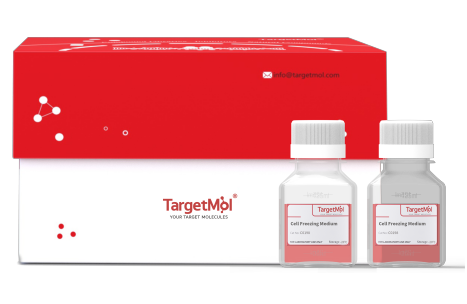
| Pack Size | Price | USA Stock | Global Stock | Quantity |
|---|---|---|---|---|
| 100 mL | $102 | - | In Stock |
 Related Products Features
Ready-to-use formulation: Can be used directly without additional preparation, significantly simplifying the cryopreservation workflow.
High post-thaw viability: The optimized ratio of DMSO and protective components effectively reduces ice crystal formation and improves cell survival after freeze–thaw cycles.
Broad applicability: Suitable for various mammalian cells, including adherent cells, suspension cells, stem cells, and primary cells.
Excellent preservation of cell status: Cells exhibit rapid recovery of morphology, proliferation capacity, and function after thawing, ensuring high experimental reproducibility.
Compatible with multiple cryopreservation conditions: Can be used in conjunction with controlled-rate freezing containers, programmable freezing systems, or manual cooling methods.
ApplicationsSuitable for long-term cryopreservation of various mammalian cells, ensuring high viability and stability after freezing and thawing.
InstructionsI. Cell Cryopreservation Procedure:
1.Cell Collection
Select cells in good condition and in the logarithmic growth phase.
For adherent cells, detach with trypsin and collect by centrifugation.
For suspension cells, collect directly by centrifugation.
Recommended centrifugation conditions: 1000 rpm for 5 min.
2.Cell Resuspension
Discard the supernatant and gently resuspend the cells in the cell freezing medium.
A recommended cell density is 1 × 10⁶–1 × 10⁷ cells/mL per vial.
3.Aliquoting
Dispense the cell suspension into sterile cryovials, approximately 1 mL per vial.
4.Controlled-Rate Freezing
Place the cryovials into a controlled-rate freezing container and cool at a rate of approximately −1 °C/min to −80 °C. Store at this temperature overnight.
5.Long-term Storage
Transfer the cryovials to liquid nitrogen (−196 °C) for long-term storage on the following day.
II. Cell Thawing Procedure:
1.Rapid Thawing
Remove the cryovial from liquid nitrogen and immediately place it in a 37 °C water bath. Gently agitate to thaw rapidly within 1–2 min.
2.Dilution and Removal of Cryoprotectant
Slowly add the thawed cell suspension into pre-warmed complete culture medium (~10 mL) while gently mixing.
3.Centrifugation
Centrifuge at 1000 rpm for 5 min, discard the supernatant, and resuspend the cells in fresh culture medium.
4.Recovery Culture
Seed the cells into appropriate culture dishes or flasks and incubate at 37 °C in a 5% CO₂ incubator.
It is recommended to replace the culture medium after 24 h to remove residual cryoprotectant.
StorageStable for 3 months at 4 °C and for 1 year at −20 °C.
Precautions1.The freezing medium should be aliquoted for storage to avoid repeated freeze–thaw cycles, which may affect component stability and protective performance.
2.It is recommended to pre-cool the freezing medium at 4 °C before use to minimize cellular stress caused by temperature fluctuations.
3.All procedures should be performed under sterile conditions to prevent microbial contamination.
4.Ensure that cells are in good condition prior to cryopreservation, in the logarithmic growth phase, with a viability of no less than 90%.
5.Cells can be stored long-term in liquid nitrogen; if stored at −80 °C, they remain stable for approximately 1 year.
6.The product is for R&D use only, not for diagnostic procedures, food, drug, household or other uses.
7.Please wear a lab coat and disposable gloves.
Instruction Manual| Size | Quantity | Unit Price | Amount | Operation |
|---|
 Feedback
 Hello! How can I help you today?
Copyright © 2015-2026 TargetMol Chemicals Inc. All Rights Reserved.
