


Shopping Cart
Remove All Your shopping cart is currently empty

Synonyms: HGS-ETR1, HGSETR1, HGS-1012, HGS1012, Anti-Human TNFRSF10A Recombinant Antibody
Mapatumumab

| Pack Size | Price | USA Stock | Global Stock | Quantity |
|---|---|---|---|---|
| 1 mg | $198 | - | In Stock | |
| 5 mg | $598 | - | In Stock | |
| 10 mg | $952 | - | In Stock | |
| 25 mg | $1,590 | - | In Stock | |
| 50 mg | Preferential | - | In Stock |
| Description | Mapatumumab (HGS-ETR1) is a fully human agonistic monoclonal antibody targeting the TNF-related apoptosis-inducing ligand receptor 1 (TRAIL-R1). Mapatumumab exhibits anticancer activity, primarily by inducing tumor cell death through the activation of the death receptor-mediated apoptosis pathway. Mapatumumab is intended for use in cancer research. |
| Targets & IC50 | TNFRSF10A/TRAILR1 (human):17.21 ng/mL (EC50) |
| In vitro | Mapatumumab (0.01–100 μg/mL) exhibited very limited activity against 23 PPTP cell lines cultured in vitro; none of the cell lines showed 50% growth inhibition. [1] Treatment of bladder cancer cells with Mapatumumab (1–100 ng/mL) and EPI (0.1–10 μg/mL) for 24 hours significantly enhanced cytotoxicity and demonstrated synergistic effects. Mapatumumab (100 ng/mL) does not activate caspase-8, caspase-9, or caspase-3 in T24 cells. [2] Methods: Colorectal cancer (Colo205, HCT116), non-small cell lung cancer (H2122), and renal cancer cells (A498) were treated with Mapatumumab (0.01, 0.1, 1, 10, 100 μg/mL) for 48 h, and cell viability was assessed using CellTiter-Glo; Caspase-3/7 activity was detected using a fluorescence assay. Results: Mapatumumab specifically binds to TRAIL-R1, dose-dependently inhibits tumor cell viability, and activates both intrinsic and extrinsic apoptotic pathways.[4] |
| In vivo | Mapatumumab (10 mg/kg, intraperitoneal administration, twice weekly for six weeks) demonstrated excessive toxicity in two neuroblastoma xenograft models (NB-1643 and NB-SD). [1] Methods: A Colo205 colorectal cancer NMRI-nu/nu nude mouse xenograft model was established; When tumor volume reached 115 ± 29 mm³, Mapatumumab was administered intraperitoneally at 10 mg/kg (on days 1, 4, and 8), combined with fractionated radiotherapy (5 × 3 Gy on days 1–5) plus a gradient boost of 0–44.2 Gy on day 8. The study was conducted under both normoxic and hypoxic conditions, with a 270-day follow-up. Tumor volume was monitored using a caliper, and the local tumor control rate was calculated. Results: The combination of Mapatumumab and radiotherapy significantly prolonged the tumor doubling time and substantially improved the local tumor control rate, with no obvious acute toxicity and good safety. [3] Methods: Nude mouse xenograft models were established using Colo205 (colorectal cancer), H2122 (NSCLC), and A498 (renal cell carcinoma). When tumor volume reached 100 mm³, Mapatumumab (2.5, 10 mg/kg) was administered intravenously, and tumor volume was monitored using a caliper. Results: Mapatumumab monotherapy significantly induced tumor regression and inhibited tumor growth; the 10 mg/kg dose group demonstrated highly significant antitumor effects.[4] |
| Synonyms | HGS-ETR1, HGSETR1, HGS-1012, HGS1012, Anti-Human TNFRSF10A Recombinant Antibody |
| Reactivity | Human |
| Verified Activity | Immobilized Human TNFRSF10A/TRAILR1/CD261 Protein (His) at 2 μg/mL can bind Mapatumumab. The EC50 is 0.01721 μg/mL. 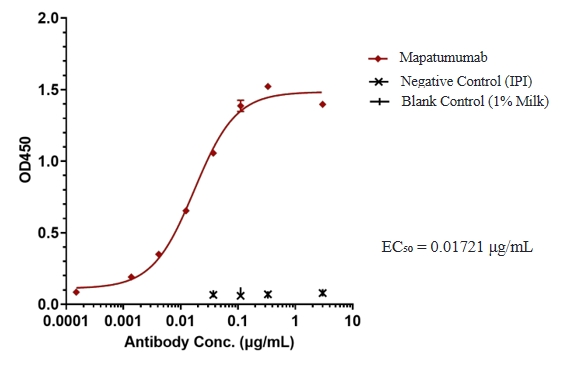 |
| Application | Functional assay |
| Antibody Type | Monoclonal |
| Formulation | Supplied as a sterile solution in a buffered formulation system (e.g., phosphate-, citrate-, or amino acid-based). Please refer to the CoA for lot-specific composition. |
| Endotoxin | <1.0 EU/mg |
| Conjucates | Unconjugated |
| Gene ID | |
| Uniprot ID | |
| Target | TNFRSF10A/TRAILR1/CD261 |
| Molecular Weight | 143.52 kDa |
| Cas No. | 658052-09-6 |
| Isotype | Human IgG2SA lambda2 |
| Recommended Isotype Control |
| Storage | Store at low temperature -20°C for 1 year Shipping with blue ice/Shipping at ambient temperature. |
| Size | Quantity | Unit Price | Amount | Operation |
|---|
 Feedback
 Hello! How can I help you today?
Copyright © 2015-2026 TargetMol Chemicals Inc. All Rights Reserved.
