


Shopping Cart
Remove All Your shopping cart is currently empty

Synonyms: p-GSK3B (Ser 9), p-GSK3B (S 9), GSK3B (p-Ser 9), GSK3B (p-S 9)
Anti-Phospho-GSK3B
(Ser 9) Antibody
(9V640)
| Pack Size | Price | USA Stock | Global Stock | Quantity |
|---|---|---|---|---|
| 50 µL | $297 | 7-10 days | 7-10 days | |
| 100 µL | $498 | 7-10 days | 7-10 days |
| Description | Anti-Phospho-GSK3B (Ser 9) Antibody (9V640) is a Rabbit antibody targeting Phospho-GSK3B (Ser 9). Anti-Phospho-GSK3B (Ser 9) Antibody (9V640) can be used in ICC/IF,IHC,WB. |
| Synonyms | p-GSK3B (Ser 9), p-GSK3B (S 9), GSK3B (p-Ser 9), GSK3B (p-S 9) |
| Ig Type | IgG |
| Clone | 9V640 |
| Reactivity | Human |
| Verified Activity | 1. Western blot analysis of Phospho-GSK3 beta (Ser 9) on different lysates using anti-Phospho-GSK3 beta (Ser 9) antibody at 1/1,000 dilution. Positive control: Lane 1: Hela, Lane 2: MCF-7. 2. Immunohistochemical analysis of paraffin-embedded human colon cancer tissue using anti-Phospho-GSK3 beta (Ser 9) antibody. Counter stained with hematoxylin. 3. Immunohistochemical analysis of paraffin-embedded human breast tissue using anti-Phospho-GSK3 beta (Ser 9) antibody. Counter stained with hematoxylin. 4. Immunohistochemical analysis of paraffin-embedded human breast carcinoma tissue using anti-Phospho-GSK3 beta (Ser 9) antibody. Counter stained with hematoxylin. 5. Immunohistochemical analysis of paraffin-embedded human kidney tissue using anti-Phospho-GSK3 beta (Ser 9) antibody. Counter stained with hematoxylin. 6. Immunohistochemical analysis of paraffin-embedded human pancreas tissue using anti-Phospho-GSK3 beta (Ser 9) antibody. Counter stained with hematoxylin. 7. ICC staining Phospho-GSK3 beta (Ser 9) in Hela cells (green). The nuclear counter stain is DAPI (blue). Cells were fixed in paraformaldehyde, permeabilised with 0.25% Triton X100/PBS. 8. ICC staining Phospho-GSK3 beta (Ser 9) in MCF-7 cells (green). The nuclear counter stain is DAPI (blue). Cells were fixed in paraformaldehyde, permeabilised with 0.25% Triton X100/PBS. 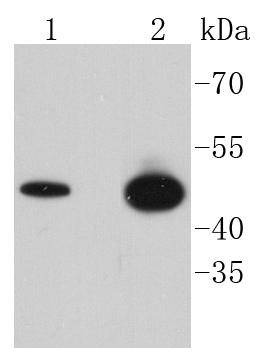 , ,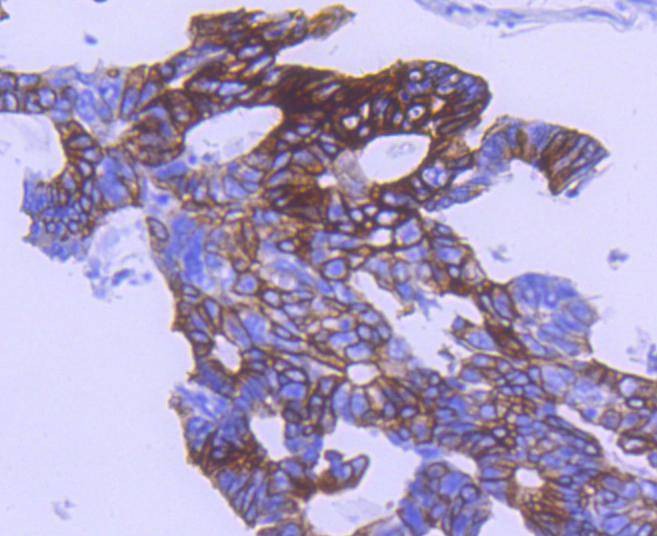 , ,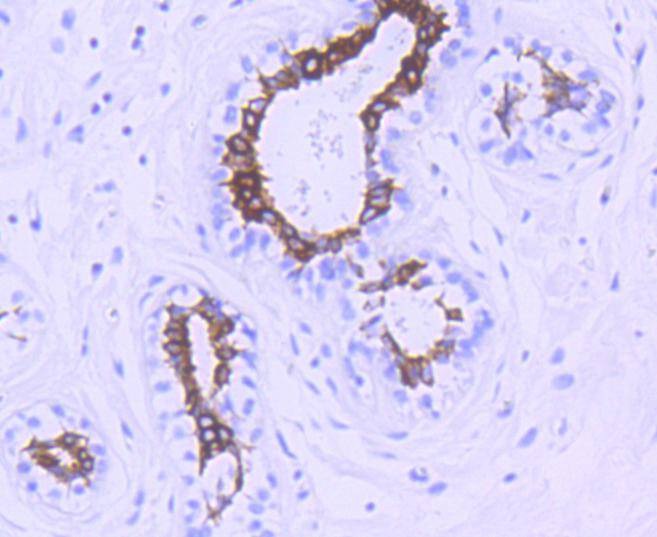 , ,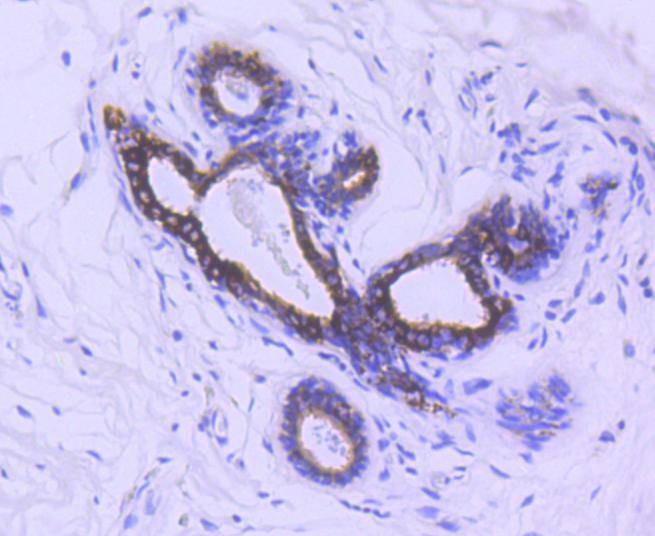 , ,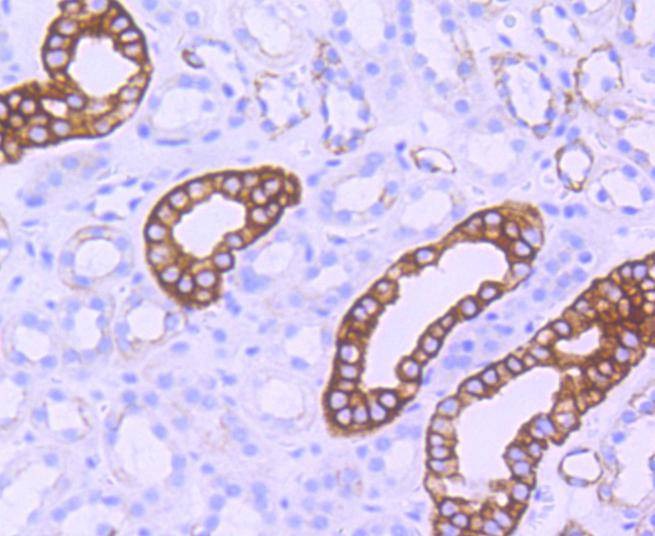 , ,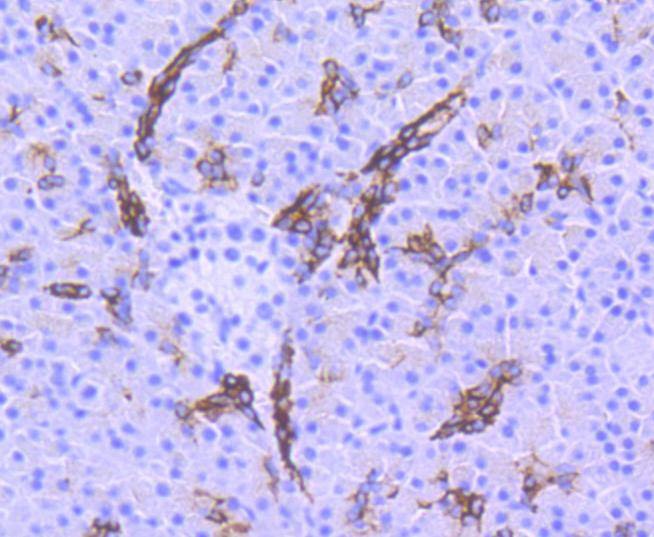 , ,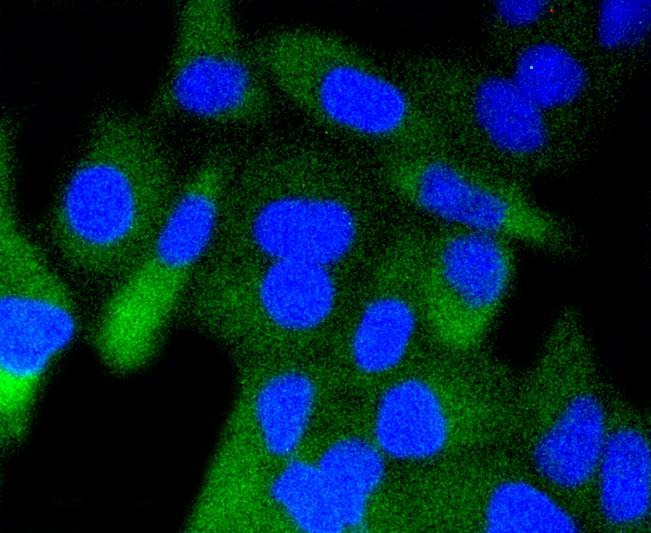 , ,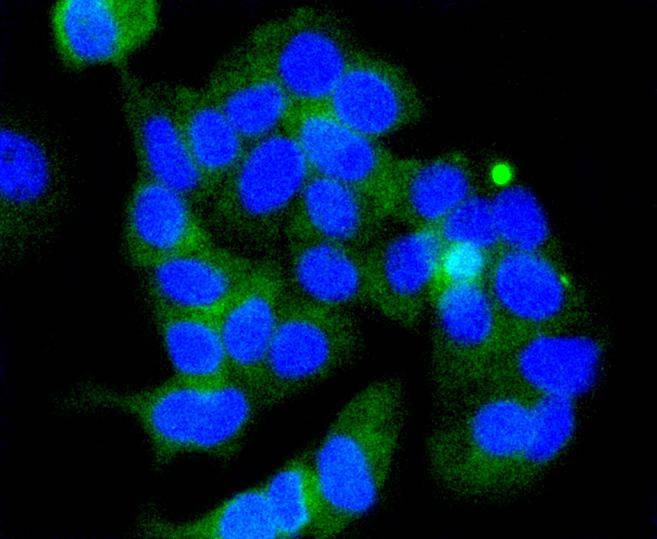 |
| Application | |
| Recommended Dose | WB: 1:1000-2000; IHC: 1:50-200; ICC/IF: 1:50-200 |
| Antibody Type | Monoclonal |
| Host Species | Rabbit |
| Construction | Recombinant Antibody |
| Purification | ProA affinity purified |
| Appearance | Liquid |
| Formulation | 1*TBS (pH7.4), 1%BSA, 40%Glycerol. Preservative: 0.05% Sodium Azide. |
| Research Background | Glycogen synthase kinase-3α (GSK-3α) and GSK-3β are highly similar isoforms of serine/ threonine kinases that regulate metabolic enzymes and transcription factors, which are responsible for coordinating processes such as glycogen synthesis and cell adhesion. GSK-3β activity is also required for nuclear activity of Rel dimers, which mediate an apoptotic response to TNFα in mice. GSK-3 catalytic kinase activity is controlled through differential phosphorylation of serine/threonine residues, which have an inhibitory effect, and tyrosine residues, which have an activating effect. Growth factor stimulation of mammalian cells expressing GSK-3α and GSK-3β induces phosphorylation of Ser 21 and Ser 9, respectively, through a phosphatidylinositol 3-kinase (PI 3-K)-protein kinase B (PKB)-dependent pathway, thereby enhancing proliferative signals. Additionally, GSK-3 physically associates with cAMP-dependent protein kinase A (PKA), which phosphorylates Ser 21 of GSK-3α or Ser 9 of GSK-3β and inactivates both forms. GSK-3α/β is positively regulated by phosphorylation on Tyr 279 and Tyr 216, respectively. Activated GSK-3α/β participates in energy metabolism, neuronal cell development, and body pattern formation. Tyrosine dephosphorylation of GSK-3 is involved in its extracellular signal-dependent inactivation. |
| Conjucates | Unconjugated |
| Others Formats | Phospho |
| Immunogen | A synthesized phosphopeptide: human GSK3 beta around the phosphorylation site of Ser9 |
| Antigen Species | Human |
| Uniprot ID |
| Molecular Weight | Theoretical: 47 kDa. |
| Stability & Storage | Store at -20°C or -80°C for 12 months. Avoid repeated freeze-thaw cycles. |
| Transport | Shipping with blue ice. |
| Size | Quantity | Unit Price | Amount | Operation |
|---|
 Feedback
 Hello! How can I help you today?
Copyright © 2015-2026 TargetMol Chemicals Inc. All Rights Reserved.
