


Shopping Cart
Remove All Your shopping cart is currently empty
Synonyms: tumor necrosis factor (ligand) superfamily, member 10, TRAIL, TL2, CD253, Apo-2L, APO2L
| Pack Size | Price | USA Stock | Global Stock | Quantity |
|---|---|---|---|---|
| 5 µg | $39 | - | In Stock | |
| 10 µg | $61 | - | In Stock | |
| 20 µg | $93 | - | In Stock | |
| 50 µg | $173 | - | In Stock | |
| 100 µg | $258 | - | In Stock | |
| 200 µg | $420 | - | In Stock | |
| 500 µg | $764 | 7-10 days | 7-10 days | |
| 1 mg | $1,260 | 7-10 days | 7-10 days |
| Bioactivity | Measured in a cytotoxicity assay using L‑929 mouse fibroblast cells in the presence of the metabolic inhibitor actinomycin D. The ED50 for this effect is 1-10 ng/mL. |
| Description | TRAIL/TNFSF10 Protein, Human, Recombinant is expressed in E. coli expression system. The predicted molecular weight is 16 kDa and the accession number is P50591. |
| Species | Human |
| Expression System | E. coli |
| Tag | Tag Free |
| Accession Number | P50591 |
| Construction | Recombinant Human TNF-Related Apoptosis-Inducing Ligand is produced by our E.coli expression system and the target gene encoding Arg115-Gly281 is expressed. |
| Protein Purity | ≥ 95 % as determined by SDS-PAGE. ≥ 95 % as determined by SEC-HPLC. 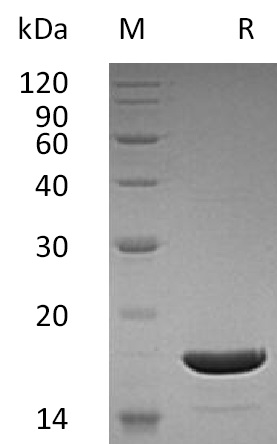 , ,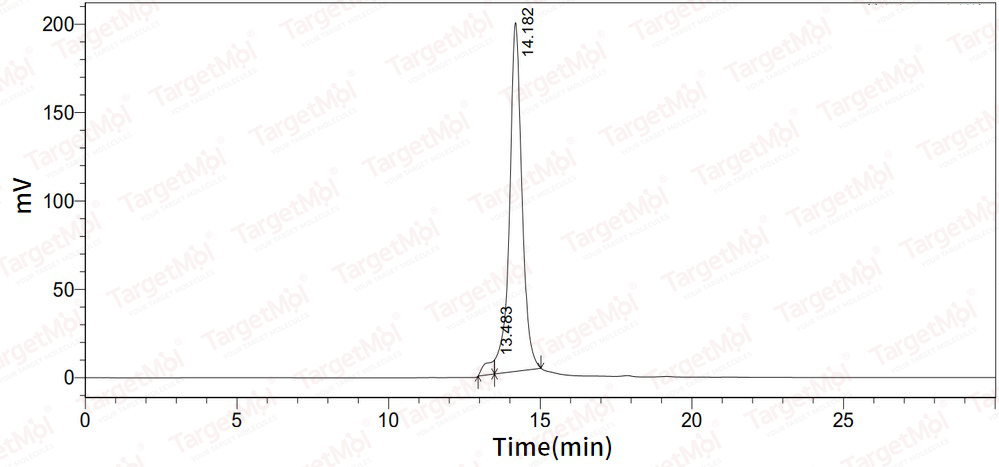 |
| Endotoxin | < 0.1 ng/µg (1 EU/µg) as determined by LAL test. |
| Formulation | Supplied as a 0.2 μm filtered solution of 40 mM Tris-HCl, 300 mM NaCl, 5% Trehalose, 5% Mannitol, 0.01% Tween 80, 10% Glycerol, pH7.0. |
| Synonyms | tumor necrosis factor (ligand) superfamily, member 10, TRAIL, TL2, CD253, Apo-2L, APO2L |
| Research Background | Tumor necrosis factor ligand superfamily member 10 (TNFSF10), also known as TNF-related apoptosis-inducing ligand (TRAIL), Apo-2 ligand, and CD253, is a cytokine that belongs to the tumor necrosis factor (TNF) ligand family. TNFSF10 / Apo-2L / CD253 functions as a ligand that induces the process of cell death called apoptosis. TNFSF10 / TRAIL shows homology to other members of the tumor necrosis factor superfamily. As one member of the cluster of differentiation system, TNFSF10 / CD253 is commonly used as cell markers in Immunophenotyping. Different kinds of cells in the immune system can be identified through the surface CD molecules which associating with the immune function of the cell. There are more than 320 CD unique clusters and subclusters have been identified. Some of the CD molecules serve as receptors or ligands important to the cell through initiating a signal cascade which then alter the behavior of the cell. Some CD proteins do not take part in cell signal process but have other functions such as cell adhesion TNFSF10 / Apo-2L / CD253 / TRAIL binds to several members of TNF receptor superfamily including TNFRSF10A / TRAILR1, TNFRSF10B / TRAILR2, TNFRSF10C / TRAILR3, TNFRSF10D / TRAILR4, and possibly also to TNFRSF11B/OPG. The activity of TNFSF10 / TRAIL may be modulated by binding to the decoy receptors TNFRSF10C / TRAILR3, TNFRSF10D/TRAILR4, and TNFRSF11B/OPG that cannot induce apoptosis. The binding of this protein to its receptors has been shown to trigger the activation of MAPK8 / JNK, caspase 8, and caspase 3. Alternatively spliced transcript variants encoding different isoforms have been found for this gene.Cancer ImmunotherapyImmune CheckpointImmunotherapyTargeted Therapy |
| Molecular Weight | 16 kDa (reducing conditions) |
| Shipping | Proteins are shipped with blue ice. |
| Storage | It is recommended to store the product under sterile conditions at -70°C or lower. Samples are stable for up to 6 months at -80°C. Please avoid multiple freeze-thaw cycles and store products in aliquots. |
| Size | Quantity | Unit Price | Amount | Operation |
|---|
 Feedback
 Hello! How can I help you today?
Copyright © 2015-2026 TargetMol Chemicals Inc. All Rights Reserved.
