


Shopping Cart
Remove All Your shopping cart is currently empty
Synonyms: orosomucoid 2, ORM2, AGP-B', AGP-B, AGP2

| Pack Size | Price | USA Stock | Global Stock | Quantity |
|---|---|---|---|---|
| 5 µg | $70 | - | In Stock | |
| 10 µg | $109 | - | In Stock | |
| 20 µg | $182 | - | In Stock | |
| 50 µg | $357 | 7-10 days | 7-10 days | |
| 100 µg | $600 | - | In Stock |
| Bioactivity | Activity testing is in progress. It is theoretically active, but we cannot guarantee it. If you require protein activity, we recommend choosing the eukaryotic expression version first. |
| Description | ORM2 belongs to the calycin superfamily, lipocalin family. Lipocalins share limited regions of sequence homology and a common tertiary structure architecture. They transport small hydrophobic molecules such as steroids, bilins, retinoids, and lipids. Lipocalins can be found in gram-negative bacteria, vertebrate cells, and invertebrate cells, and plants. They are associated with many biological processes. ORM2 functions as a transport protein in the bloodstream. It is expressed by the liver and secreted in plasma. It seems that ORM2 function in modulating the activity of the immune system during the acute-phase reaction. It binds various hydrophobic ligands in the interior of its beta-barrel domain. It also binds synthetic drugs and influences their distribution and availability. |
| Species | Human |
| Expression System | HEK293 Cells |
| Tag | C-His |
| Accession Number | P19652 |
| Construction | A DNA sequence encoding the human ORM2 (P19652) (Met1-Ser201) was expressed with a polyhistidine tag at the C-terminus. Predicted N terminal: Gln 19 |
| Protein Purity | > 90 % as determined by SDS-PAGE 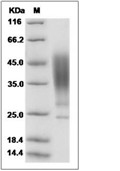 |
| Endotoxin | < 1.0 EU/μg of the protein as determined by the LAL method. |
| Formulation | Lyophilized from a solution filtered through a 0.22 μm filter, containing PBS, pH 7.4. Typically, a mixture containing 5% to 8% trehalose, mannitol, and 0.01% Tween 80 is incorporated as a protective agent before lyophilization. |
| Reconstitution | Reconstituted with sterile deionized water to 0.25 mg/mL. Reconstitution conditions may vary depending on the lot. |
| Synonyms | orosomucoid 2, ORM2, AGP-B', AGP-B, AGP2 |
| Research Background | ORM2 belongs to the calycin superfamily, lipocalin family. Lipocalins share limited regions of sequence homology and a common tertiary structure architecture. They transport small hydrophobic molecules such as steroids, bilins, retinoids, and lipids. Lipocalins can be found in gram-negative bacteria, vertebrate cells, and invertebrate cells, and plants. They are associated with many biological processes. ORM2 functions as a transport protein in the bloodstream. It is expressed by the liver and secreted in plasma. It seems that ORM2 function in modulating the activity of the immune system during the acute-phase reaction. It binds various hydrophobic ligands in the interior of its beta-barrel domain. It also binds synthetic drugs and influences their distribution and availability. |
| Molecular Weight | 23.1 kDa (predicted); 23 kDa (reducing conditions) |
| Shipping | In general, lyophilized powders are shipped with blue ice, while solutions are shipped with dry ice. |
| Storage | It is recommended to store recombinant proteins at -20°C to -80°C for future use. Lyophilized powders can be stably stored for over 12 months, while liquid products can be stored for 6-12 months at -80°C. For reconstituted protein solutions, the solution can be stored at -20°C to -80°C for at least 3 months. Please avoid multiple freeze-thaw cycles and store products in aliquots. |
| Size | Quantity | Unit Price | Amount | Operation |
|---|
 Feedback
 Hello! How can I help you today?
Copyright © 2015-2026 TargetMol Chemicals Inc. All Rights Reserved.
