


Shopping Cart
Remove All Your shopping cart is currently empty
Synonyms: skeletal receptor tyrosine-protein kinase, MUSK, Muscle-specific tyrosine-protein kinase receptor (MuSK;Muscle-specific kinase receptor), Muscle, skeletal receptor tyrosine-protein kinase
| Pack Size | Price | USA Stock | Global Stock | Quantity |
|---|---|---|---|---|
| 5 µg | $86 | 20 days | 20 days | |
| 10 µg | $138 | 20 days | 20 days | |
| 20 µg | $231 | - | In Stock | |
| 50 µg | $348 | 20 days | 20 days | |
| 100 µg | $480 | 20 days | 20 days | |
| 200 µg | $743 | 20 days | 20 days | |
| 500 µg | $1,330 | 20 days | 20 days |
| Bioactivity | Activity has not been tested. It is theoretically active, but we cannot guarantee it. If you require protein activity, we recommend choosing the eukaryotic expression version first. |
| Description | MUSK Protein, Human, Recombinant (His) is expressed in yeast with N-6xHis tag. The predicted molecular weight is 53.8 kDa and the accession number is O15146. |
| Species | Human |
| Expression System | P. pastoris (Yeast) |
| Tag | N-6xHis |
| Accession Number | O15146 |
| Amino Acid | LPKAPVITTPLETVDALVEEVATFMCAVESYPQPEISWTRNKILIKLFDTRYSIRENGQLLTILSVEDSDDGIYCCTANNGVGGAVESCGALQVKMKPKITRPPINVKIIEGLKAVLPCTTMGNPKPSVSWIKGDSPLRENSRIAVLESGSLRIHNVQKEDAGQYRCVAKNSLGTAYSKVVKLEVEEESEPEQDTKVFARILRAPESHNVTFGSFVTLHCTATGIPVPTITWIENGNAVSSGSIQESVKDRVIDSRLQLFITKPGLYTCIATNKHGEKFSTAKAAATISIAEWREYCLAVKELFCAKEWLVMEEKTHRGLYRSEMHLLSVPECSKLPSMHWDPTACARLPHLAFPPMTSSKPSVDIPNLPSSSSSSFSVSPTYSMTVIISIMSSFAIFVLLTITTLYCCRRRKQWKNKKRESAAVTLTTLPSELLLDRLHPNPMYQRMPLLLNPKLLSLEYPRNNIEYVRDI |
| Construction | 24-495 aa |
| Protein Purity | > 90% as determined by SDS-PAGE. 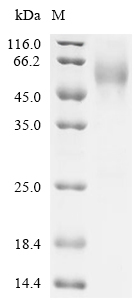 |
| Endotoxin | < 1.0 EU/μg of the protein as determined by the LAL method. |
| Formulation | Tris-based buffer, 50% glycerol |
| Reconstitution | Reconstitute the lyophilized protein in distilled water. The product concentration should not be less than 100 μg/ml. Before opening, centrifuge the tube to collect powder at the bottom. After adding the reconstitution buffer, avoid vortexing or pipetting for mixing. |
| Synonyms | skeletal receptor tyrosine-protein kinase, MUSK, Muscle-specific tyrosine-protein kinase receptor (MuSK;Muscle-specific kinase receptor), Muscle, skeletal receptor tyrosine-protein kinase |
| Research Background | Receptor tyrosine kinase which plays a central role in the formation and the maintenance of the neuromuscular junction (NMJ), the synapse between the motor neuron and the skeletal muscle. Recruitment of AGRIN by LRP4 to the MUSK signaling complex induces phosphorylation and activation of MUSK, the kinase of the complex. The activation of MUSK in myotubes regulates the formation of NMJs through the regulation of different processes including the specific expression of genes in subsynaptic nuclei, the reorganization of the actin cytoskeleton and the clustering of the acetylcholine receptors (AChR) in the postsynaptic membrane. May regulate AChR phosphorylation and clustering through activation of ABL1 and Src family kinases which in turn regulate MUSK. DVL1 and PAK1 that form a ternary complex with MUSK are also important for MUSK-dependent regulation of AChR clustering. May positively regulate Rho family GTPases through FNTA. Mediates the phosphorylation of FNTA which promotes prenylation, recruitment to membranes and activation of RAC1 a regulator of the actin cytoskeleton and of gene expression. Other effectors of the MUSK signaling include DNAJA3 which functions downstream of MUSK. May also play a role within the central nervous system by mediating cholinergic responses, synaptic plasticity and memory formation. |
| Molecular Weight | 53.8 kDa (predicted) |
| Shipping | In general, lyophilized powders are shipped with blue ice, while solutions are shipped with dry ice. |
| Storage | Lyophilized powders can be stably stored for over 12 months, while liquid products can be stored for 6-12 months at -80°C. For reconstituted protein solutions, the solution can be stored at -20°C to -80°C for at least 3 months. Please avoid multiple freeze-thaw cycles and store products in aliquots. |
| Size | Quantity | Unit Price | Amount | Operation |
|---|
 Feedback
 Hello! How can I help you today?
Copyright © 2015-2026 TargetMol Chemicals Inc. All Rights Reserved.
