


Shopping Cart
Remove All Your shopping cart is currently empty
Synonyms: PUM, PEMT, PEM, mucin 1, cell surface associated, Mucin 1, MUC1/ZD, MUC-1/X, MUC-1/SEC, MUC-1, MCKD1, MCKD, MCD, MAM6, KL-6, H23AG, EMA, CD227, CA15-3, ADMCKD1, ADMCKD
| Pack Size | Price | USA Stock | Global Stock | Quantity |
|---|---|---|---|---|
| 5 µg | $31 | - | In Stock | |
| 10 µg | $46 | 7-10 days | 7-10 days | |
| 20 µg | $72 | 7-10 days | 7-10 days | |
| 50 µg | $135 | 7-10 days | 7-10 days | |
| 100 µg | $222 | - | In Stock | |
| 200 µg | $382 | 7-10 days | 7-10 days |
| Bioactivity | Activity testing is in progress. It is theoretically active, but we cannot guarantee it. If you require protein activity, we recommend choosing the eukaryotic expression version first. |
| Description | Mucin-1/MUC1 Protein, Human, Recombinant (hFc) is expressed in HEK293 mammalian cells with hFc tag. The predicted molecular weight is 42 kDa and the accession number is P15941-11. |
| Species | Human |
| Expression System | HEK293 Cells |
| Tag | C-hFc |
| Accession Number | P15941-11 |
| Construction | A DNA sequence encoding the human MUC1 isoform 2 (NP_001018016.1) extracellular domain (Met 1-Gly 167) was fused with the Fc region of human IgG1 at the C-terminus. Predicted N terminal: Ser 33 |
| Protein Purity | > 90 % as determined by SDS-PAGE 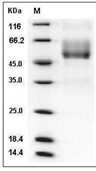 |
| Endotoxin | < 1.0 EU/μg of the protein as determined by the LAL method. |
| Formulation | Lyophilized from a solution filtered through a 0.22 μm filter, containing PBS, pH 7.4. Typically, a mixture containing 5% to 8% trehalose, mannitol, and 0.01% Tween 80 is incorporated as a protective agent before lyophilization. |
| Reconstitution | Reconstituted with sterile deionized water to 0.25 mg/mL. Reconstitution conditions may vary depending on the lot. |
| Synonyms | PUM, PEMT, PEM, mucin 1, cell surface associated, Mucin 1, MUC1/ZD, MUC-1/X, MUC-1/SEC, MUC-1, MCKD1, MCKD, MCD, MAM6, KL-6, H23AG, EMA, CD227, CA15-3, ADMCKD1, ADMCKD |
| Research Background | Mucin 1, cell surface-associated (MUC1) or polymorphic epithelial mucin (PEM) is a membrane-bound protein that is a member of the mucin family. Mucins are O-glycosylated proteins that play an essential role in forming protective mucous barriers on epithelial surfaces. These proteins also play a role in intracellular signaling. This protein is expressed on the apical surface of epithelial cells that line the mucosal surfaces of many different tissues including lung, breast stomach, and pancreas. MUC-1/CC1/CD227 Exclusively located in the apical domain of the plasma membrane of highly polarized epithelial cells. After endocytosis, internalized, and recycled to the cell membrane. This protein is proteolytically cleaved into alpha and beta subunits that form a heterodimeric complex. The N-terminal alpha subunit functions in cell-adhesion and the C-terminal beta subunit is involved in cell signaling. Overexpression, aberrant intracellular localization, and changes in glycosylation of this protein have been associated with carcinomas. The alpha subunit has cell adhesive properties. MUC-1/CC1/CD227 Can act both as an adhesion and an anti-adhesion protein. This protein May provide a protective layer on epithelial cells against bacterial and enzyme attack. The beta subunit contains a C-terminal domain which is involved in cell signaling, through phosphorylations and protein-protein interactions. MUC-1/CC1/CD227 participated in modulates signaling in ERK, SRC, and NF-kappa-B pathways. In the activated T-cells, MUC-1/CC1/CD227 influences directly or indirectly the Ras/MAPK pathway. MUC-1/CC1/CD227 Promotes tumor progression and regulates TP53-mediated transcription and determines cell fate in the genotoxic stress response. Binds, together with KLF4, the PE21 promoter element of TP53 and represses TP53 activity.Cancer ImmunotherapyImmune CheckpointImmunotherapyTargeted Therapy |
| Molecular Weight | 42 kDa (predicted); 55-60 kDa (reducing condition, due to glycosylation) |
| Shipping | In general, lyophilized powders are shipped with blue ice, while solutions are shipped with dry ice. |
| Storage | It is recommended to store recombinant proteins at -20°C to -80°C for future use. Lyophilized powders can be stably stored for over 12 months, while liquid products can be stored for 6-12 months at -80°C. For reconstituted protein solutions, the solution can be stored at -20°C to -80°C for at least 3 months. Please avoid multiple freeze-thaw cycles and store products in aliquots. |
| Size | Quantity | Unit Price | Amount | Operation |
|---|
 Feedback
 Hello! How can I help you today?
Copyright © 2015-2026 TargetMol Chemicals Inc. All Rights Reserved.
