


Shopping Cart
Remove All Your shopping cart is currently empty
Synonyms: Protein p63, LMP-1, LMP1, Latent membrane protein 1
| Pack Size | Price | USA Stock | Global Stock | Quantity |
|---|---|---|---|---|
| 5 µg | $129 | 20 days | 20 days | |
| 10 µg | $216 | 20 days | 20 days | |
| 20 µg | $360 | - | In Stock | |
| 50 µg | $543 | 20 days | 20 days | |
| 100 µg | $745 | 20 days | 20 days | |
| 200 µg | $1,070 | 20 days | 20 days | |
| 500 µg | $1,730 | 20 days | 20 days | |
| 1 mg | $2,530 | 20 days | 20 days |
| Bioactivity | Activity has not been tested. It is theoretically active, but we cannot guarantee it. If you require protein activity, we recommend choosing the eukaryotic expression version first. |
| Description | Acts as a CD40 functional homolog to prevent apoptosis of infected B-lymphocytes and drive their proliferation. Functions as a constitutively active tumor necrosis factor receptor that induces the activation of several signaling pathways, including those of the NF-kappa-B family. LMP1 signaling leads to up-regulation of antiapoptotic proteins and provide growth signals in latently infected cells. Interacts with host UBE2I and subsequently affects the sumoylation state of several cellular proteins. For example, induces the sumoylation of host IRF7 thereby limiting its transcriptional activity and modulating the activation of innate immune responses. Inhibits also host IFN-alpha-stimulated STAT2 nuclear translocation and interferon-stimulated response element transcriptional activity by interacting with and inhibiting host TYK2. |
| Species | EBV |
| Expression System | E. coli |
| Tag | N-10xHis, C-Myc |
| Accession Number | Q1HVB3 |
| Amino Acid | YYHGQRHSDEHHHDDSLPHPQQATDDSGHESDSNSNEGRHHLLVTGAGDGPPLCSQNLGAPGGGPDNGPQDPDNTDDNGPQDPDNTDDNGPQDPDNTDDNGPQDPDNTADNGPHDPLPHNPSDSAGNDGGPPNLTEEVENKGGDRGPPSMTDGGGGDPHLPTLLLGTSGSGGDDDDPHGPVQLSYYD |
| Construction | 185-371 aa |
| Protein Purity | > 85% as determined by SDS-PAGE. 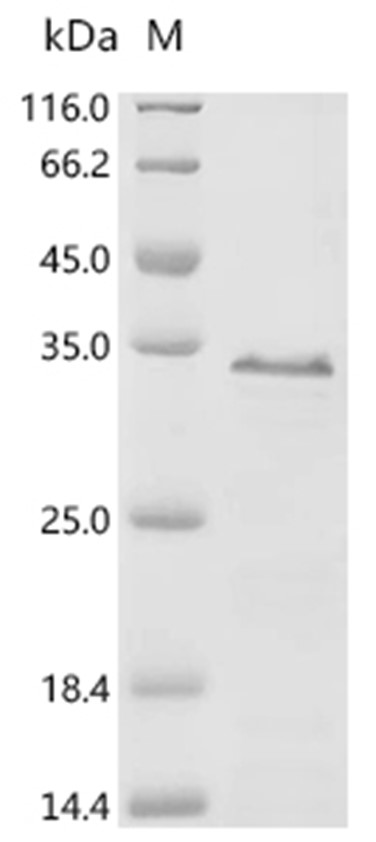 |
| Endotoxin | < 1.0 EU/μg of the protein as determined by the LAL method. |
| Formulation | Tris-based buffer, 50% glycerol |
| Reconstitution | Reconstitute the lyophilized protein in distilled water. The product concentration should not be less than 100 μg/ml. Before opening, centrifuge the tube to collect powder at the bottom. After adding the reconstitution buffer, avoid vortexing or pipetting for mixing. |
| Synonyms | Protein p63, LMP-1, LMP1, Latent membrane protein 1 |
| Research Background | Acts as a CD40 functional homolog to prevent apoptosis of infected B-lymphocytes and drive their proliferation. Functions as a constitutively active tumor necrosis factor receptor that induces the activation of several signaling pathways, including those of the NF-kappa-B family. LMP1 signaling leads to up-regulation of antiapoptotic proteins and provide growth signals in latently infected cells. Interacts with host UBE2I and subsequently affects the sumoylation state of several cellular proteins. For example, induces the sumoylation of host IRF7 thereby limiting its transcriptional activity and modulating the activation of innate immune responses. Inhibits also host IFN-alpha-stimulated STAT2 nuclear translocation and interferon-stimulated response element transcriptional activity by interacting with and inhibiting host TYK2. |
| Molecular Weight | 24.3 kDa (predicted) |
| Shipping | In general, lyophilized powders are shipped with blue ice, while solutions are shipped with dry ice. |
| Storage | Lyophilized powders can be stably stored for over 12 months, while liquid products can be stored for 6-12 months at -80°C. For reconstituted protein solutions, the solution can be stored at -20°C to -80°C for at least 3 months. Please avoid multiple freeze-thaw cycles and store products in aliquots. |
| Size | Quantity | Unit Price | Amount | Operation |
|---|
 Feedback
 Hello! How can I help you today?
Copyright © 2015-2026 TargetMol Chemicals Inc. All Rights Reserved.
