


Shopping Cart
Remove All Your shopping cart is currently empty
Synonyms: TYRO6, hEK2, HEK2, ETK2, Ephrin type-B receptor 3, EPH-like kinase 2, EPHB3, EK2
| Pack Size | Price | USA Stock | Global Stock | Quantity |
|---|---|---|---|---|
| 10 µg | $1,390 | 35 days | 35 days |
| Bioactivity | The specific activity of EPBH3 was determined to be 26-30 nmol /min/mg by radioactive kinase assay. |
| Description | EphB3 Protein, Human, Recombinant (GST) is expressed in Baculovirus-Insect Cells. The accession number is P54753. |
| Species | Human |
| Expression System | Baculovirus-Insect Cells |
| Tag | N-GST |
| Accession Number | P54753 |
| Construction | Recombinant human EPHB3 (585-end) was expressed by baculovirus in Sf9 insect cells using an N-terminal GST tag. |
| Protein Purity | >80% as determined by SDS-PAGE. 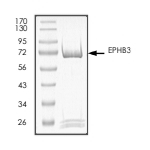 |
| Formulation | Supplied as sterile 50 mM Tris-HCl, pH 7.5, 150 mM NaCl, 10 mM glutathione, 0.1 mM EDTA, 0.25 mM DTT, 0.1 mM PMSF, 25% glycerol. |
| Synonyms | TYRO6, hEK2, HEK2, ETK2, Ephrin type-B receptor 3, EPH-like kinase 2, EPHB3, EK2 |
| Research Background | Ephrin type-B receptor 3, also known as EphB3 or HEK2, belongs to the ephrin receptor subfamily of the protein-tyrosine kinase family which 16 known receptors (14 found in mammals) are involved: EPHA1, EPHA2, EPHA3, EPHA4, EPHA5, EPHA6, EPHA7, EPHA8, EPHA9, EPHA10, EPHB1, EPHB2, EPHB3, EPHB4, EPHB5, EPHB6. The Eph family of receptor tyrosine kinases (comprising EphA and EphB receptors) has been implicated in synapse formation and the regulation of synaptic function and plasticity6. Ephrin receptors are components of cell signalling pathways involved in animal growth and development, forming the largest sub-family of receptor tyrosine kinases (RTKs). Ligand-mediated activation of Ephs induces various important downstream effects and Eph receptors have been studied for their potential roles in the development of cancer. EphB receptor tyrosine kinases are enriched at synapses, suggesting that these receptors play a role in synapse formation or function. We find that EphrinB binding to EphB induces a direct interaction of EphB with NMDA-type glutamate receptors. This interaction occurs at the cell surface and is mediated by the extracellular regions of the two receptors, but does not require the kinase activity of EphB. |
| Molecular Weight | ~68 kDa |
| Shipping | Enzymes are highly recommended to be shipped at frozen temperature with dry ice. Shipment made at ambient temperature may seriously affect the activity of the ordered products. |
| Storage | Lyophilized powders can be stably stored for over 12 months, while liquid products can be stored for 6-12 months at -80°C. For reconstituted protein solutions, the solution can be stored at -20°C to -80°C for at least 3 months. Please avoid multiple freeze-thaw cycles and store products in aliquots. |
| Size | Quantity | Unit Price | Amount | Operation |
|---|
 Feedback
 Hello! How can I help you today?
Copyright © 2015-2026 TargetMol Chemicals Inc. All Rights Reserved.
