


Shopping Cart
Remove All Your shopping cart is currently empty
Synonyms: Tyrosine-protein kinase receptor ESK, mEpha1, Esk, Ephrin type-A receptor 1, Epha1, Embryonic stem cell kinase
| Pack Size | Price | USA Stock | Global Stock | Quantity |
|---|---|---|---|---|
| 10 µg | $1,390 | 35 days | 35 days |
| Bioactivity | The specific activity of EPHA1 was determined to be 36 nmol/min/mg by radioactive kinase assay. |
| Description | EphA1 Protein, Mouse, Recombinant (GST) is expressed in Baculovirus-Insect Cells. The accession number is Q60750. |
| Species | Mouse |
| Expression System | Baculovirus-Insect Cells |
| Tag | N-GST |
| Accession Number | Q60750 |
| Construction | Recombinant mouse EPHA1 (569-end) was expressed by baculovirus in Sf9 insect cells using a N-terminal GST tag. |
| Protein Purity | >85% as determined by SDS-PAGE. 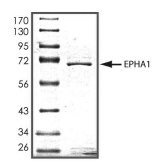 |
| Formulation | Supplied as sterile 50 mM Tris-HCl, pH 7.5, 150 mM NaCl, 10 mM glutathione, 0.1 mM EDTA, 0.25 mM DTT, 0.1 mM PMSF, 25% glycerol. |
| Synonyms | Tyrosine-protein kinase receptor ESK, mEpha1, Esk, Ephrin type-A receptor 1, Epha1, Embryonic stem cell kinase |
| Research Background | EPHA1 or EPH receptor A1 belongs to the ephrin receptor subfamily of the protein-tyrosine kinase family. Receptors in the EPH subfamily typically have a single kinase domain and an extracellular region containing a Cys-rich domain and 2 fibronectin type III repeats. An important role of Eph receptors and their ligands ephrins is to mediate cell-contact-dependent repulsion. Eph receptors and ephrins also act at boundaries to channel neuronal growth cones along specific pathways, restrict the migration of neural crest cells, and via bidirectional signaling prevent intermingling between hindbrain segments. Eph receptors and ephrins can also trigger an adhesive response of endothelial cells and are required for the remodeling of blood vessels. Eph receptors and ephrins have emerged as key regulators of the repulsion and adhesion of cells that underlie the establishment, maintainence, and remodeling of patterns of cellular organization. The ephrins and Eph receptors are implicated as positional labels that may guide the development of neural topographic maps. |
| Molecular Weight | ~71 kDa |
| Shipping | Enzymes are highly recommended to be shipped at frozen temperature with dry ice. Shipment made at ambient temperature may seriously affect the activity of the ordered products. |
| Storage | Lyophilized powders can be stably stored for over 12 months, while liquid products can be stored for 6-12 months at -80°C. For reconstituted protein solutions, the solution can be stored at -20°C to -80°C for at least 3 months. Please avoid multiple freeze-thaw cycles and store products in aliquots. |
| Size | Quantity | Unit Price | Amount | Operation |
|---|
 Feedback
 Hello! How can I help you today?
Copyright © 2015-2026 TargetMol Chemicals Inc. All Rights Reserved.
