


Shopping Cart
Remove All Your shopping cart is currently empty
Synonyms: Tyrosine-protein kinase CSK, Protein-tyrosine kinase CYL, C-Src kinase, CSK
| Pack Size | Price | USA Stock | Global Stock | Quantity |
|---|---|---|---|---|
| 10 µg | $1,390 | 35 days | 35 days |
| Bioactivity | The specific activity of CSK was determined to be 109 nmol /min/mg by radioactive kinase assay. |
| Description | CSK Protein, Human, Recombinant is expressed in Baculovirus-Insect Cells. The accession number is P41240. |
| Species | Human |
| Expression System | Baculovirus-Insect Cells |
| Tag | Tag free |
| Accession Number | P41240 |
| Construction | Recombinant full length tag-free human CSK was expressed by baculovirus in Sf9 insect cells. |
| Protein Purity | >85% as determined by SDS-PAGE. 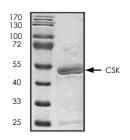 |
| Formulation | Supplied as sterile 50 mM Tris-HCl, pH 7.5, 150 mM NaCl, 0.25 mM DTT, 0.1 mM PMSF and 25% glycerol. |
| Synonyms | Tyrosine-protein kinase CSK, Protein-tyrosine kinase CYL, C-Src kinase, CSK |
| Research Background | The tyrosine kinase c-Src has been implicated as a modulator of cell proliferation, spreading, and migration. These functions are also regulated by Met. The structure of a large fragment of the c-Src kinase comprises the regulatory and kinase domains and the carboxy-terminal tall. c-Src kinase interactions among domains and is stabilized by binding of the phosphorylated tail to the SH2 domain. This molecule is locked in a conformation that simultaneously disrupts the kinase active site and sequesters the binding surfaces of the SH2 and SH3 domains. The structure shows how appropriate cellular signals, or transforming mutations in v-Src, could break these interactions to produce an open, active kinase. The protein-tyrosine kinase activity of c-Src kinase is inhibited by phosphorylation of tyr527, within the c-Src c-terminal tail. Genetic and biochemical data have suggested that this negative regulation requires an intact Src homology 2 (SH2) domain. Since SH2 domains recognize phosphotyrosine, it is possible that these two non-catalytic domains associate, and thereby repress c-Src kinase activity. Experiments have suggested that c-Src kinase plays a role in the biological behaviour of colonic carcinoma cells induced by migratory factors such as EGF, perhaps acting in conjunction with FAK to regulate focal adhesion turnover and tumour cell motility. Furthermore, although c-Src kinase has been implicated in colonic tumour progression, in the adenoma to carcinoma in vitro model c-Src is not the driving force for this progression but co-operates with other molecules in carcinoma development.References |
| Molecular Weight | ~52 kDa |
| Shipping | Enzymes are highly recommended to be shipped at frozen temperature with dry ice. Shipment made at ambient temperature may seriously affect the activity of the ordered products. |
| Storage | Lyophilized powders can be stably stored for over 12 months, while liquid products can be stored for 6-12 months at -80°C. For reconstituted protein solutions, the solution can be stored at -20°C to -80°C for at least 3 months. Please avoid multiple freeze-thaw cycles and store products in aliquots. |
| Size | Quantity | Unit Price | Amount | Operation |
|---|
 Feedback
 Hello! How can I help you today?
Copyright © 2015-2026 TargetMol Chemicals Inc. All Rights Reserved.
