


Shopping Cart
Remove All Your shopping cart is currently empty
Synonyms: KIAA1791, hCDK13, Cyclin-dependent kinase 13, CHED, CDK13, CDC2L5, CDC2L
| Pack Size | Price | USA Stock | Global Stock | Quantity |
|---|---|---|---|---|
| 20 µg | $953 | 35 days | 35 days |
| Bioactivity | Activity has not been tested. It is theoretically active, but we cannot guarantee it. |
| Description | CDK13 Protein, Human, Recombinant (GST) is expressed in Baculovirus-Insect Cells. The accession number is Q14004. |
| Species | Human |
| Expression System | Baculovirus-Insect Cells |
| Tag | N-GST |
| Accession Number | Q14004 |
| Construction | Recombinant human CDK13 (516-end) was expressed by baculovirus in Sf9 insect cells using an N-terminal GST tag. |
| Protein Purity | >70% as determined by SDS-PAGE. 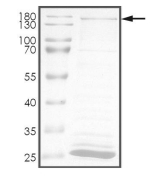 |
| Formulation | Supplied as sterile 50 mM Tris-HCl, pH 7.5, 150 mM NaCl, 10 mM glutathione, 0.1 mM EDTA, 0.25 mM DTT, 0.1 mM PMSF, 25% glycerol. |
| Synonyms | KIAA1791, hCDK13, Cyclin-dependent kinase 13, CHED, CDK13, CDC2L5, CDC2L |
| Research Background | cyclin-dependent kinase 12 (CDK12) and 13 evolved by duplication of a common gene ancestor, a single paralog being found in non-vertebrates deuterostomes. In mammalian cells, both kinases operate in separate complexes, which could have different functions. CDK13 is localised in the nucleus and particularly in speckles, the storage site for splicing factors. CDK13 plays a role in splicing regulation by controlling the phosphorylation status and the activity of splicing factors. CDK13 interacts with p32 a protein associating with the splicing factor SRSF1 (also known as ASF/SF2). Through its association with p32 and by phosphorylating SRSF1, CDK13 increases the mRNA splicing of human immunodeficient virus type 1 (HIV-1) and its overexpression, suppresses virus production. |
| Molecular Weight | ~160 kDa |
| Shipping | Enzymes are highly recommended to be shipped at frozen temperature with dry ice. Shipment made at ambient temperature may seriously affect the activity of the ordered products. |
| Storage | Lyophilized powders can be stably stored for over 12 months, while liquid products can be stored for 6-12 months at -80°C. For reconstituted protein solutions, the solution can be stored at -20°C to -80°C for at least 3 months. Please avoid multiple freeze-thaw cycles and store products in aliquots. |
| Size | Quantity | Unit Price | Amount | Operation |
|---|
 Feedback
 Hello! How can I help you today?
Copyright © 2015-2026 TargetMol Chemicals Inc. All Rights Reserved.
