


Shopping Cart
Remove All Your shopping cart is currently empty
Synonyms: MGC47866, MGC129964, L-SIGN, LSIGN, HP10347, DC-SIGNR, DCSIGNR, DC-SIGN2, C-type lectin domain family 4 member M, CLEC4M, CD299, CD209L
| Pack Size | Price | USA Stock | Global Stock | Quantity |
|---|---|---|---|---|
| 5 µg | $55 | - | In Stock | |
| 10 µg | $86 | - | In Stock | |
| 20 µg | $139 | - | In Stock | |
| 50 µg | $269 | - | In Stock | |
| 100 µg | $451 | - | In Stock | |
| 200 µg | $771 | 7-10 days | 7-10 days | |
| 500 µg | $1,560 | 7-10 days | 7-10 days |
| Bioactivity | Activity testing is in progress. It is theoretically active, but we cannot guarantee it. If you require protein activity, we recommend choosing the eukaryotic expression version first. |
| Description | CD299 Protein, Human, Recombinant (hFc) is expressed in HEK293 mammalian cells with hFc tag. The predicted molecular weight is 65 kDa and the accession number is Q9H2X3-1. |
| Species | Human |
| Expression System | HEK293 Cells |
| Tag | N-hFc |
| Accession Number | Q9H2X3-1 |
| Construction | A DNA sequence encoding the extracellular domain (Ser 78-Glu 399) of human DC-SIGNR (NP_055072.3) was fused with the Fc region of human IgG1 at the N-terminus. Predicted N terminal: Glu 20 |
| Protein Purity | > 90 % as determined by SDS-PAGE 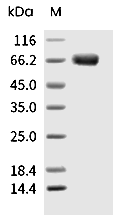 |
| Endotoxin | < 1.0 EU/μg of the protein as determined by the LAL method. |
| Formulation | Lyophilized from a solution filtered through a 0.22 μm filter, containing PBS, pH 7.4. Typically, a mixture containing 5% to 8% trehalose, mannitol, and 0.01% Tween 80 is incorporated as a protective agent before lyophilization. |
| Reconstitution | Reconstituted with sterile deionized water to 0.1 mg/mL. Reconstitution conditions may vary depending on the lot. |
| Synonyms | MGC47866, MGC129964, L-SIGN, LSIGN, HP10347, DC-SIGNR, DCSIGNR, DC-SIGN2, C-type lectin domain family 4 member M, CLEC4M, CD299, CD209L |
| Research Background | C-type lectin domain family 4, member M, also known as DC-SIGNR and CLEC4M, is a type II integral membrane protein that is 77% amino acid identical to DC-SIGN, an HIV gp120-binding protein. Though the encoded gene located in the same chromosome, DC-SIGN is expressed solely on dendritic cells, while DC-SIGNR is predominantly found in liver sinusoidal endothelial cells and lymph node, as well as placental endothelium. DC-SIGNR exists as a homotetramer, and the tandem repeat domain, also called neck domain, mediates oligomerization. DC-SIGNR is regarded as a pathogen-recognition receptor involved in peripheral immune surveillance in liver, and probably mediates the endocytosis of pathogens which are subsequently degraded in lysosomal compartments. DC-SIGNR appears to selectively recognize and bind many viral surface glycoproteins containing high mannose N-linked oligosaccharides in a calcium-dependent manner, including HIV-1 gp120, HIV-2 gp120, SIV gp120, ebolavirus glycoproteins, HCV E2, and human SARS coronavirus protein S, as well as the cellular adhesion protein ICAM3. DC-SIGNR has been thought to play an important role in establishing HIV infection by enhancing trans-infection of CD4(+)T cells in the regional lymph nodes. It may affect susceptibility to HIV infection by a mechanism that is different in females and males. DC-SIGNR can bind to hepatitis C virus (HCV), and its polymorphism might affect HCV loads supporting the concept that DC-SIGNR contributes to HCV replication efficacy. |
| Molecular Weight | 65 kDa (predicted); 65.83 kDa (reducing condition, due to glycosylation) |
| Shipping | In general, lyophilized powders are shipped with blue ice, while solutions are shipped with dry ice. |
| Storage | It is recommended to store recombinant proteins at -20°C to -80°C for future use. Lyophilized powders can be stably stored for over 12 months, while liquid products can be stored for 6-12 months at -80°C. For reconstituted protein solutions, the solution can be stored at -20°C to -80°C for at least 3 months. Please avoid multiple freeze-thaw cycles and store products in aliquots. |
| Size | Quantity | Unit Price | Amount | Operation |
|---|
 Feedback
 Hello! How can I help you today?
Copyright © 2015-2026 TargetMol Chemicals Inc. All Rights Reserved.
