


Shopping Cart
Remove All Your shopping cart is currently empty
Synonyms: CaMKI-alpha, CaM-KI, Camk1, CaM kinase I alpha, CaM kinase I, Calcium/calmodulin-dependent protein kinase type 1
| Pack Size | Price | USA Stock | Global Stock | Quantity |
|---|---|---|---|---|
| 10 µg | $1,390 | 35 days | 35 days |
| Bioactivity | The specific activity of CAMK1 was determined to be 169 nmol /min/mg by ADP-Glo kinase assay. |
| Description | CAMKI Protein, Mouse, Recombinant (GST) is expressed in E. coli. The accession number is Q91YS8. |
| Species | Mouse |
| Expression System | E. coli |
| Tag | N-GST |
| Accession Number | Q91YS8 |
| Construction | Recombinant full length mouse CAMK1 was expressed in E. coli cells using an N-terminal GST tag. |
| Protein Purity | >90% as determined by SDS-PAGE. 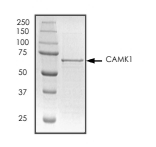 |
| Formulation | Supplied as sterile 50 mM Tris-HCl, pH 7.5, 150 mM NaCl, 10 mM glutathione, 0.1 mM EDTA, 0.25 mM DTT, 0.1 mM PMSF, 25% glycerol. |
| Synonyms | CaMKI-alpha, CaM-KI, Camk1, CaM kinase I alpha, CaM kinase I, Calcium/calmodulin-dependent protein kinase type 1 |
| Research Background | Calcium/calmodulin-dependent protein kinase or CaM kinases are serine/threonine-specific protein kinases that are primarily regulated by the Calcium/calmodulin complex. These kinases show a memory effect on activation. CaM kinases activity can outlast the intracellular calcium transient that is needed to activate it. Inneurons, this property is important for the induction of synaptic plasticity. Pharmacological inhibition of CaM kinases II blocks the induction of long-term potentiation. Upon activation, CaM kinases II phosphorylates postsynaptic glutamate receptors and changes the electrical properties of the synapse. Calcium/calmodulin-dependent protein kinase type 1D, also known as CaM kinase I delta, CaM kinase ID, CaMKI-like protein kinase, CKLiK and CAMK1D, is a member of theprotein kinase superfamily and CaMK subfamily. It contains oneprotein kinase domain. CAMK1D is broadly expressed. It is highly and mostly expressed in polymorphonuclear leukocytes (neutrophilic and eosinophilic granulocytes) while little or no expression is observed in monocytes and lymphocytes. Engineered overexpression of CAMK1D in non-tumorigenic breast epithelial cells led to increased cell proliferation, and molecular and phenotypic alterations indicative of epithelial-mesenchymal transition (EMT), including loss of cell-cell adhesions and increased cell migration and invasion. CAMK1D is a potential therapeutic target with particular relevance to clinically unfavorable basal-like tumors. |
| Molecular Weight | ~169 kDa |
| Shipping | Enzymes are highly recommended to be shipped at frozen temperature with dry ice. Shipment made at ambient temperature may seriously affect the activity of the ordered products. |
| Storage | Lyophilized powders can be stably stored for over 12 months, while liquid products can be stored for 6-12 months at -80°C. For reconstituted protein solutions, the solution can be stored at -20°C to -80°C for at least 3 months. Please avoid multiple freeze-thaw cycles and store products in aliquots. |
| Size | Quantity | Unit Price | Amount | Operation |
|---|
 Feedback
 Hello! How can I help you today?
Copyright © 2015-2026 TargetMol Chemicals Inc. All Rights Reserved.
