


Shopping Cart
Remove All Your shopping cart is currently empty
Synonyms: VWS1, CLICK3, CLICK III, CaMK-like CREB kinase III, CaMKIG, CaM-KI gamma, CaMKI gamma, CAMK1G, CaM kinase IG
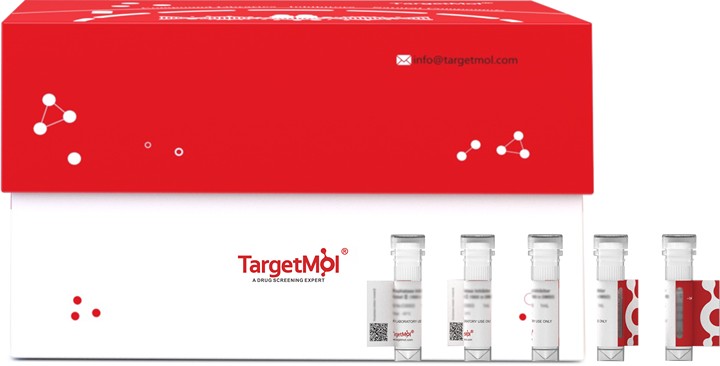
| Pack Size | Price | USA Stock | Global Stock | Quantity |
|---|---|---|---|---|
| 10 µg | $1,390 | 35 days | 35 days |
| Bioactivity | Representative specific activity data for CAMK1γ were obtained using different assay formats:
- 788 nmol/min/mg, determined by radioactive kinase assay
- 101 nmol/min/mg, determined by ADP-Glo kinase assay, corresponding to 675 nmol/min/mg in the radioactive kinase assay
Different lots may be tested using different assay methods; therefore, values obtained using different assay formats are not directly comparable. |
| Description | CAMKI gamma/CAMK1G Protein, Human, Recombinant (aa 1-330, GST) is expressed in Baculovirus-Insect Cells. The accession number is Q96NX5. |
| Species | Human |
| Expression System | Baculovirus-Insect Cells |
| Tag | N-GST |
| Accession Number | Q96NX5 |
| Construction | Recombinant human CAMK1 gamma (1-330) was expressed by baculovirus in Sf9 insect cells using a N-terminal GST tag. |
| Protein Purity | >90% as determined by SDS-PAGE. 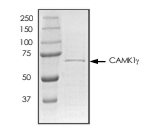 |
| Formulation | Supplied as sterile 50 mM Tris-HCl, pH 7.5, 150 mM NaCl, 10 mM glutathione, 0.1 mM EDTA, 0.25 mM DTT, 0.1 mM PMSF, 25% glycerol. |
| Synonyms | VWS1, CLICK3, CLICK III, CaMK-like CREB kinase III, CaMKIG, CaM-KI gamma, CaMKI gamma, CAMK1G, CaM kinase IG |
| Research Background | Calmodulin-Dependent Protein Kinase (CaM Kinase) is a kind of protein phosphorylate multiple downstream targets. Concentration of cytosolic calcium functions as a second messenger that mediates a wide range of cellular responses. Calcium binds to calcium binding proteins (calmodulin/CaM) and stimulates the activity of a variety of enzymes, including CaM kinases referred to as CaM-kinases (CaMKs), such as CaMKI, CaMKII, CaMKIV and CaMKK. Calmodulin-dependent protein kinase CL3/CaMKIγ is a memberane-anchored CaMK belonging to the CaM kinase family. Its C-terminal region is uniquely modified by two sequential lipidification steps: prenylation followed by a kinase-activity-regulated palmitoylation. These modifications are essential for CaMKIγ membrane anchoring and targeting into detergent-resistant lipid microdomains in the dendrites. It has been found that CaMKIγ critically contributed to BDNF-stimulated dendritic growth. Raft insertion of CaMKIγ specifically promoted dendritogenesis of cortical neurons by acting upstream of RacGEF STEF and Rac, both present in lipid rafts. Thus, CaMKIγ may represent a key element in the Ca2+-dependent and lipid-raft-delineated switch that turns on extrinsic activity-regulated dendrite formation in developing cortical neurons. |
| Molecular Weight | ~69 kDa |
| Shipping | Enzymes are highly recommended to be shipped at frozen temperature with dry ice. Shipment made at ambient temperature may seriously affect the activity of the ordered products. |
| Storage | Lyophilized powders can be stably stored for over 12 months, while liquid products can be stored for 6-12 months at -80°C. For reconstituted protein solutions, the solution can be stored at -20°C to -80°C for at least 3 months. Please avoid multiple freeze-thaw cycles and store products in aliquots. |
| Size | Quantity | Unit Price | Amount | Operation |
|---|
 Feedback
 Hello! How can I help you today?
Copyright © 2015-2026 TargetMol Chemicals Inc. All Rights Reserved.
