


Shopping Cart
Remove All Your shopping cart is currently empty
Synonyms: SKR5, CD292, Bone morphogenetic protein receptor type-1A, BMPR-1A, BMPR1A, BMP type-1A receptor, ALK-3, ALK3, ACVRLK3
| Pack Size | Price | USA Stock | Global Stock | Quantity |
|---|---|---|---|---|
| 10 µg | $1,390 | 35 days | 35 days |
| Bioactivity | The specific activity of ALK3 (BMPR1A) was determined to be 1.2 nmol /min/mg by radioactive kinase assay. |
| Description | BMPR1A/ALK-3 Protein, Human, Recombinant (GST) is expressed in Baculovirus-Insect Cells. The accession number is P36894. |
| Species | Human |
| Expression System | Baculovirus-Insect Cells |
| Tag | N-GST |
| Accession Number | P36894 |
| Construction | Recombinant human ALK3 (BMPR1A) (187-end) was expressed by baculovirus in Sf9 insect cells using an N-terminal GST tag. |
| Protein Purity | >90% as determined by SDS-PAGE. 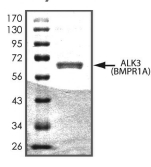 |
| Formulation | Supplied as sterile 50 mM Tris-HCl, pH 7.5, 150 mM NaCl, 10 mM glutathione, 0.1 mM EDTA, 0.25 mM DTT, 0.1 mM PMSF, 25% glycerol. |
| Synonyms | SKR5, CD292, Bone morphogenetic protein receptor type-1A, BMPR-1A, BMPR1A, BMP type-1A receptor, ALK-3, ALK3, ACVRLK3 |
| Research Background | Activin receptor-Like Kinase 3 (ALK-3), also known as Bone Morphogenetic Protein Receptor, type IA (BMPR1A), is a type I receptor for bone morphogenetic proteins (BMPs) which belong to the transforming growth factor beta (TGF-β) superfamily. The BMP receptors form a subfamily of transmembrane serine/threonine kinases including the type I receptors BMPR1A and BMPR1B and the type II receptor BMPR2. ALK-3/BMPR1A is expressed in the epithelium during branching morphogenesis. Deletion of BMPR1A in the epithelium with an Sftpc-cre transgene leads to dramatic defects in lung development. ALK-3 and ALK-6 share a high degree of homology, yet possess distinct signaling roles. The transforming growth factor (TGF)-beta type III receptor (TbetaRIII) enhanced both ALK-3 and ALK-6 signaling. TbetaRIII associated with ALK-3 primarily through their extracellular domains, whereas its interaction with ALK-6 required both the extracellular and cytoplasmic domains. ALK-3 plays an essential role in the formation of embryonic ventral abdominal wall, and abrogation of BMP signaling activity due to gene mutations in its signaling components could be one of the underlying causes of omphalocele at birth. The type IA BMP receptor, ALK-3 was specifically required at mid-gestation for normal development of the trabeculae, compact myocardium, interventricular septum, and endocardial cushion. Cardiac muscle lacking ALK-3 was specifically deficient in expressing TGFbeta2, an established paracrine mediator of cushion morphogenesis. Hence, ALK-3 is essential, beyond just the egg cylinder stage, for myocyte-dependent functions and signals in cardiac organogenesis. |
| Molecular Weight | ~66 kDa |
| Shipping | Enzymes are highly recommended to be shipped at frozen temperature with dry ice. Shipment made at ambient temperature may seriously affect the activity of the ordered products. |
| Storage | Lyophilized powders can be stably stored for over 12 months, while liquid products can be stored for 6-12 months at -80°C. For reconstituted protein solutions, the solution can be stored at -20°C to -80°C for at least 3 months. Please avoid multiple freeze-thaw cycles and store products in aliquots. |
| Size | Quantity | Unit Price | Amount | Operation |
|---|
 Feedback
 Hello! How can I help you today?
Copyright © 2015-2026 TargetMol Chemicals Inc. All Rights Reserved.
