


Shopping Cart
Remove All Your shopping cart is currently empty
Synonyms: Tumor necrosis factor ligand superfamily member 13, TRDL-1, TNFSF13, TNF-related death ligand 1, TNF- and APOL-related leukocyte expressed ligand 2, TALL-2, CD256, APRIL, A proliferation-inducing ligand
| Pack Size | Price | USA Stock | Global Stock | Quantity |
|---|---|---|---|---|
| 5 µg | $178 | 7-10 days | 7-10 days | |
| 10 µg | $283 | - | In Stock | |
| 20 µg | $538 | 7-10 days | 7-10 days | |
| 50 µg | $793 | 7-10 days | 7-10 days | |
| 100 µg | $1,269 | 7-10 days | 7-10 days | |
| 200 µg | $2,030 | 7-10 days | 7-10 days | |
| 500 µg | $3,553 | 7-10 days | 7-10 days |
| Bioactivity | 1. Loaded Cynomolgus BCMA-Fc on Protein A Biosensor, can bind Human APRIL-His with an affinity constant of 0.005 nM as determined in BLI assay. (Regularly tested)
2. Immobilized Human APRIL -Flag-His at 1μg/ml (100 μl/well) can bind Cynomolgus BCMA-Fc. The ED50 of Cynomolgus BCMA-Fc is 4.23 ng/ml. (Regularly tested); |
| Description | APRIL (a proliferation-inducing ligand), also known as TNFSF13, TALL2, TRDL1, and CD256, is a member of the TNF ligand superfamily. It is synthesized as a 32 kDa proprotein which is cleaved by furin in the Golgi to release the active 17 kDa soluble molecule. Secreted human APRIL, which consists almost entirely of a single TNF homology domain, shares 85% amino acid sequence identity with mouse and rat APRIL. Both APRIL and its close relative BAFF bind and signal through the TNF superfamily receptors TACI and BCMA, while BAFF additionally functions through BAFF R. APRIL binds to heparan sulfate proteoglycans (HSPGs) independently of its binding to TACI and BCMA. APRIL can form bioactive heterotrimers with BAFF, and these circulate in the serum of patients with rheumatic immune disorders. APRIL enhances the proliferation and survival of plasma cells and also promotes T cell-dependent humoral responses. APRIL levels are elevated in the serum during coronary artery disease, and it is also elevated in many cancers primarily due to expression by tumor-infiltratin neutrophils. |
| Species | Human |
| Expression System | HEK293 Cells |
| Tag | N-Flag-His |
| Accession Number | O75888 |
| Amino Acid | Lys112-Leu250 |
| Construction | Lys112-Leu250 |
| Protein Purity | Greater than 95% as determined by reducing SDS-PAGE. (QC verified) 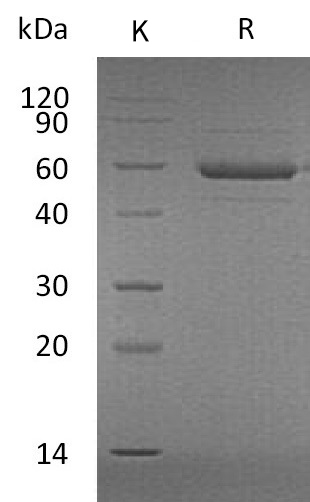 |
| Endotoxin | < 0.1 ng/µg (1 EU/µg) as determined by LAL test. |
| Formulation | Lyophilized from a solution filtered through a 0.22 μm filter, containing 20 mM PB, 1M NaCl, pH8.3. |
| Reconstitution | Reconstitute the lyophilized protein in distilled water. The product concentration should not be less than 100 μg/ml. Before opening, centrifuge the tube to collect powder at the bottom. After adding the reconstitution buffer, avoid vortexing or pipetting for mixing. |
| Synonyms | Tumor necrosis factor ligand superfamily member 13, TRDL-1, TNFSF13, TNF-related death ligand 1, TNF- and APOL-related leukocyte expressed ligand 2, TALL-2, CD256, APRIL, A proliferation-inducing ligand |
| Research Background | APRIL (a proliferation-inducing ligand), also known as TNFSF13, TALL2, TRDL1, and CD256, is a member of the TNF ligand superfamily. It is synthesized as a 32 kDa proprotein which is cleaved by furin in the Golgi to release the active 17 kDa soluble molecule. Secreted human APRIL, which consists almost entirely of a single TNF homology domain, shares 85% amino acid sequence identity with mouse and rat APRIL. Both APRIL and its close relative BAFF bind and signal through the TNF superfamily receptors TACI and BCMA, while BAFF additionally functions through BAFF R. APRIL binds to heparan sulfate proteoglycans (HSPGs) independently of its binding to TACI and BCMA. APRIL can form bioactive heterotrimers with BAFF, and these circulate in the serum of patients with rheumatic immune disorders. APRIL enhances the proliferation and survival of plasma cells and also promotes T cell-dependent humoral responses. APRIL levels are elevated in the serum during coronary artery disease, and it is also elevated in many cancers primarily due to expression by tumor-infiltratin neutrophils. |
| Molecular Weight | 60 KDa (reducing condition) |
| Shipping | In general, lyophilized powders are shipped with blue ice, while solutions are shipped with dry ice. |
| Storage | Lyophilized powders can be stably stored for over 12 months, while liquid products can be stored for 6-12 months at -80°C. For reconstituted protein solutions, the solution can be stored at -20°C to -80°C for at least 3 months. Please avoid multiple freeze-thaw cycles and store products in aliquots. |
| Size | Quantity | Unit Price | Amount | Operation |
|---|
 Feedback
 Hello! How can I help you today?
Copyright © 2015-2026 TargetMol Chemicals Inc. All Rights Reserved.
