


Shopping Cart
Remove All Your shopping cart is currently empty
Synonyms: TSR-I, SKR1, ALK-2, ALK2, ACVRLK2, ACVR1, ACTR-I, Activin receptor type-1
| Pack Size | Price | USA Stock | Global Stock | Quantity |
|---|---|---|---|---|
| 10 µg | $1,390 | Inquiry | Inquiry |
| Bioactivity | Representative specific activity data for ALK2 were obtained using different assay formats:
- 40 nmol/min/mg, determined by radioactive kinase assay
- 2.1 nmol/min/mg, determined by ADP-Glo kinase assay
Different lots may be tested using different assay methods; therefore, values obtained using different assay formats are not directly comparable. |
| Description | ALK-2/ACVR1 Protein, Human, Recombinant (GST) is expressed in Baculovirus-Insect Cells. The accession number is Q04771. |
| Species | Human |
| Expression System | Baculovirus-Insect Cells |
| Tag | N-GST |
| Accession Number | Q04771 |
| Construction | Recombinant human ALK2 (147-end) was expressed by baculovirus in Sf9 insect cells using an N-terminal GST tag. |
| Protein Purity | >95% as determined by SDS-PAGE. 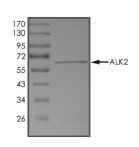 |
| Formulation | Supplied as sterile 50 mM Tris-HCl, pH 7.5, 150 mM NaCl, 10 mM glutathione, 0.1 mM EDTA, 0.25 mM DTT, 0.1 mM PMSF, and 25% glycerol. |
| Synonyms | TSR-I, SKR1, ALK-2, ALK2, ACVRLK2, ACVR1, ACTR-I, Activin receptor type-1 |
| Research Background | ALK-2, also termed as ACVR1, was initially identified as an activin type I receptor because of its ability to bind activin in concert with ActRII or ActRIIB. ALK-2 is also identified as a BMP type I receptor. It has been demonstrated that ALK-2 forms complex with either the BMP-2/7-bound BMPR-II or ACVR2A /ACVR2B. ALK-1 and ALK-2 presenting in the yeast Saccharomyces cerevisiae are two haspin homologues. Both ALK-1 and ALK-2 exhibit a weak auto-kinase activity in vitro, and are phosphoproteins in vivo. ALK-1 and ALK-2 levels peak in mitosis and late-S/G2. Control of protein stability plays a major role in ALK-2 regulation. The half-life of ALK-2 is particularly short in G1. Overexpression of ALK-2, but not of ALK-1, causes a mitotic arrest, which is correlated to the kinase activity of the protein. This suggests a role for ALK-2 in the control of mitosis. Endoglin is phosphorylated on cytosolic domain threonine residues by the TGF-beta type I receptors ALK-2 and ALK-5 in prostate cancer cells. Endoglin did not inhibit cell migration in the presence of constitutively active ALK-2. Defects in ALK-2 are a cause of fibrodysplasia ossificans progressiva (FOP). |
| Molecular Weight | ~67 kDa |
| Shipping | Enzymes are highly recommended to be shipped at frozen temperature with dry ice. Shipment made at ambient temperature may seriously affect the activity of the ordered products. |
| Storage | Lyophilized powders can be stably stored for over 12 months, while liquid products can be stored for 6-12 months at -80°C. For reconstituted protein solutions, the solution can be stored at -20°C to -80°C for at least 3 months. Please avoid multiple freeze-thaw cycles and store products in aliquots. |
| Size | Quantity | Unit Price | Amount | Operation |
|---|
 Feedback
 Hello! How can I help you today?
Copyright © 2015-2026 TargetMol Chemicals Inc. All Rights Reserved.
