


Shopping Cart
Remove All Your shopping cart is currently empty
Synonyms: RAC-PK-beta, RAC-beta serine/threonine-protein kinase, RAC protein kinase beta, Protein kinase B beta (PKB beta), Protein kinase Akt-2, AKT2
| Pack Size | Price | USA Stock | Global Stock | Quantity |
|---|---|---|---|---|
| 10 µg | $1,350 | 35 days | 35 days |
| Bioactivity | The specific activity of AKT2 (E17K) was determined to be 130 nmol /min/mg by radioactive kinase assay. |
| Description | AKT2 Protein, Human, Recombinant (E17K, GST) is expressed in Baculovirus-Insect Cells. The accession number is P31751. |
| Species | Human |
| Expression System | Baculovirus-Insect Cells |
| Tag | N-GST |
| Accession Number | P31751 |
| Construction | Recombinant full length human AKT2 (E17K) was expressed by baculovirus in Sf9 insect cells using an N-terminal GST tag. |
| Protein Purity | >95% as determined by SDS-PAGE. 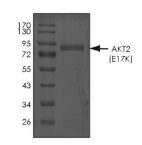 |
| Formulation | Supplied as sterile 50 mM Tris-HCl, pH 7.5, 150 mM NaCl, 10 mM glutathione, 0.1 mM EDTA, 0.25 mM DTT, 0.1 mM PMSF, 25% glycerol. |
| Synonyms | RAC-PK-beta, RAC-beta serine/threonine-protein kinase, RAC protein kinase beta, Protein kinase B beta (PKB beta), Protein kinase Akt-2, AKT2 |
| Research Background | AKT (AK mouse plus Transforming or Thymoma) is a frequent oncogene expressed in most tissues which includes three isoforms AKT1, AKT2, and AKT3. Hyperactivation of AKT signaling is a central key in many human cancer progressions, through modulating angiogenesis, tumor growth, and cell migration, invasion, metastasis, and chemoresistance. Among all three isoforms, AKT2 is most related to cancer cell invasion, metastasis, and survival. Amplification and overexpression of AKT2 have been shown in many cancers. Accumulating evidence shows the potential role of different miRNA involvements in cancer progression by activating or suppressing AKT2 expression. The AKT2/NAB1/SPK1 pathway is a novel regulating factor of macrophage migration and cardiac remodeling after myocardial infarction. The novel mechanism of the AKT2-PKM2-STAT3/NF-kappaB axis in the regulation of ovarian cancer progression, that both AKT2 and PKM2 may be potential targets for the treatment of ovarian cancer. AKT1 and AKT2, the AKT isoforms that are highly expressed in skeletal muscle, have distinct and overlapping functions, with AKT2 more important for insulin-stimulated glucose metabolism. In adipocytes, AKT2 versus AKT1 has greater susceptibility for insulin-mediated redistribution from cytosolic to membrane localization, and insulin also causes subcellular redistribution of AKT Substrate of 160 kDa (AS160), an AKT2 substrate and crucial mediator of insulin-stimulated glucose transport. |
| Molecular Weight | ~85 kDa |
| Shipping | Enzymes are highly recommended to be shipped at frozen temperature with dry ice. Shipment made at ambient temperature may seriously affect the activity of the ordered products. |
| Storage | Lyophilized powders can be stably stored for over 12 months, while liquid products can be stored for 6-12 months at -80°C. For reconstituted protein solutions, the solution can be stored at -20°C to -80°C for at least 3 months. Please avoid multiple freeze-thaw cycles and store products in aliquots. |
| Size | Quantity | Unit Price | Amount | Operation |
|---|
 Feedback
 Hello! How can I help you today?
Copyright © 2015-2026 TargetMol Chemicals Inc. All Rights Reserved.
