


Shopping Cart
Remove All Your shopping cart is currently empty

Synonyms:
| Pack Size | Price | USA Stock | Global Stock | Quantity |
|---|---|---|---|---|
| 1 mg | Inquiry | Inquiry | Inquiry | |
| 5 mg | Inquiry | Inquiry | Inquiry | |
| 10 mg | Inquiry | Inquiry | Inquiry |
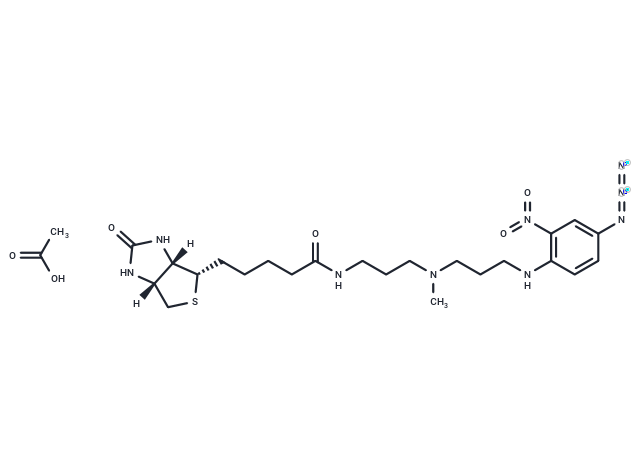
| Description | Photobiotin (acetate) is a biological probe employed in the investigation of protein interactions and enzymatic reactions among various biochemical processes. This molecule, equipped with a photosensitive group, utilizes photochemical cross-linking technology to bind with specific target molecules like proteins and nucleic acids, enabling their labeling and detection. During the photosensitive cross-linking, Photobiotin (acetate) engages in covalent bonding, forming stable compounds. Furthermore, its significant biocompatibility and bioactivity make it extensively applicable in biomedical research areas such as enzymology, proteomics, and Western blotting. As a click chemistry reagent, Photobiotin (acetate) contains an Azide group, facilitating copper-catalyzed azide-alkyne cycloaddition reactions (CuAAc) with Alkyne-containing molecules. It can also partake in strain-promoted azide-alkyne cycloaddition reactions (SPAAC) with molecules containing DBCO or BCN groups. |
| Formula | C25H39N9O6S |
| Cas No. | 96087-38-6 |
| Smiles | C(C)(O)=O.C(CCCC(NCCCN(CCCNC1=C(N(=O)=O)C=C(N=[N+]=[N-])C=C1)C)=O)[C@H]2[C@@]3([C@](CS2)(NC(=O)N3)[H])[H] .xC2H4O2 |
| Storage | Powder: -20°C for 3 years | In solvent: -80°C for 1 year Shipping with blue ice/Shipping at ambient temperature. |
 For example, if the intended dosage is 10 mg/kg for animals weighing 20 g , with a dosing volume of 100 μL per animal, and a total of 10 animals are to be administered, using a formulation of
  10% DMSO+ 40% PEG300+ 5% Tween 80+ 45% Saline/PBS/ddH2O , the resulting working solution concentration would be 2 mg/mL.
Dissolve 2 mg of the compound in 100 μL DMSO to obtain a stock solution at a concentration of 20 mg/mL . If the required concentration exceeds the compound's known solubility, please contact us for technical support before proceeding.
1) Add 100 μL of the DMSO stock solution to 400 µL PEG300 and mix thoroughly until the solution becomes clear.
2) Add 50 µL Tween 80 and mix well until fully clarified.
3) Add 450 µL Saline,PBS or ddH2O and mix thoroughly until a homogeneous solution is obtained.
| Size | Quantity | Unit Price | Amount | Operation |
|---|
 Feedback
 Hello! How can I help you today?
Copyright © 2015-2026 TargetMol Chemicals Inc. All Rights Reserved.
