


Shopping Cart
Remove All Your shopping cart is currently empty

Synonyms: NACHRA7, CHRNA7-2
Anti-CHRNA7 Monoclonal Antibody
(3V784)
| Pack Size | Price | USA Stock | Global Stock | Quantity |
|---|---|---|---|---|
| 50 µL | $297 | 7-10 days | 7-10 days | |
| 100 µL | $428 | 7-10 days | 7-10 days |
| Description | Anti-CHRNA7 Monoclonal Antibody (3V784) is a Mouse antibody targeting CHRNA7. Anti-CHRNA7 Monoclonal Antibody (3V784) can be used in IHC,FCM. |
| Synonyms | NACHRA7, CHRNA7-2 |
| Ig Type | IgG1 |
| Clone | 3V784 |
| Reactivity | Human,Mouse,Rat,Rabbit |
| Verified Activity | 1. Immunohistochemical analysis of paraffin-embedded human bladder cancer tissue using anti-CHRNA7 antibody. Counter stained with hematoxylin. 2. Immunohistochemical analysis of paraffin-embedded human rectum cancer tissue using anti-CHRNA7 antibody. Counter stained with hematoxylin. 3. Flow cytometric analysis of SH-SY5Y cells with CHRNA7 antibody at 1/100 dilution (green) compared with an unlabelled control (cells without incubation with primary antibody; red). 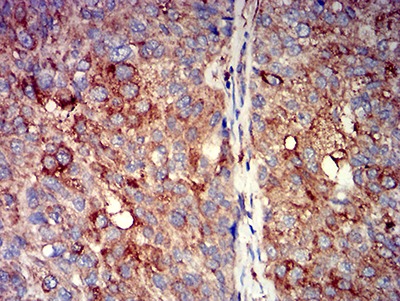 , ,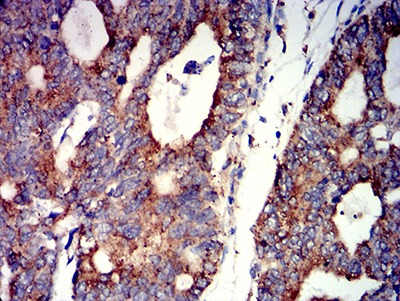 , ,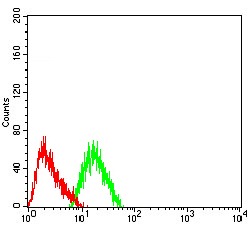 |
| Application | |
| Recommended Dose | IHC: 1/100-1/500; FCM: 1/200-1/400 |
| Antibody Type | Monoclonal |
| Host Species | Mouse |
| Construction | Hybridoma Monoclonal Antibody |
| Purification | Purified by protein A or protein G |
| Appearance | Liquid |
| Formulation | PBS with 0.05% sodium azide |
| Concentration | 1 mg/mL |
| Research Background | The nicotinic acetylcholine receptors (nAChRs) are members of a superfamily of ligand-gated ion channels that mediate fast signal transmission at synapses. The nAChRs are thought to be hetero-pentamers composed of homologous subunits. The proposed structure for each subunit is a conserved N-terminal extracellular domain followed by three conserved transmembrane domains, a variable cytoplasmic loop, a fourth conserved transmembrane domain, and a short C-terminal extracellular region. The protein encoded by this gene forms a homo-oligomeric channel, displays marked permeability to calcium ions and is a major component of brain nicotinic receptors that are blocked by, and highly sensitive to, alpha-bungarotoxin. Once this receptor binds acetylcholine, it undergoes an extensive change in conformation that affects all subunits and leads to opening of an ion-conducting channel across the plasma membrane. This gene is located in a region identified as a major susceptibility locus for juvenile myoclonic epilepsy and a chromosomal location involved in the genetic transmission of schizophrenia. An evolutionarily recent partial duplication event in this region results in a hybrid containing sequence from this gene and a novel FAM7A gene. Alternative splicing results in multiple transcript variants. |
| Conjucates | Unconjugated |
| Immunogen | Purified recombinant fragment of human CHRNA7 (AA: extra 52-259) expressed in E. Coli. |
| Antigen Species | Human |
| Gene Name | CHRNA7 |
| Gene ID | |
| Protein Name | Neuronal acetylcholine receptor subunit alpha-7 |
| Uniprot ID |
| Molecular Weight | Theoretical: 56 kDa. |
| Stability & Storage | Store at -20°C or -80°C for 12 months. Avoid repeated freeze-thaw cycles. |
| Transport | Shipping with blue ice. |
| Size | Quantity | Unit Price | Amount | Operation |
|---|
 Feedback
 Hello! How can I help you today?
Copyright © 2015-2026 TargetMol Chemicals Inc. All Rights Reserved.
