


Shopping Cart
Remove All Your shopping cart is currently empty
Synonyms: Serine-protein kinase PCK1, Phosphoenolpyruvate carboxykinase, cytosolic [GTP], PEPCK-C, PEPCK1, PCK1, cytosolic [GTP]

| Pack Size | Price | USA Stock | Global Stock | Quantity |
|---|---|---|---|---|
| 5 µg | $75 | - | In Stock | |
| 10 µg | $119 | - | In Stock | |
| 20 µg | $198 | - | In Stock | |
| 50 µg | $297 | 20 days | 20 days | |
| 100 µg | $427 | - | In Stock | |
| 200 µg | $658 | 20 days | 20 days | |
| 500 µg | $1,170 | 20 days | 20 days | |
| 1 mg | $1,830 | 20 days | 20 days |
| Bioactivity | Activity has not been tested. It is theoretically active, but we cannot guarantee it. If you require protein activity, we recommend choosing the eukaryotic expression version first. |
| Description | PCK1 Protein, Human, Recombinant (His) is expressed in E. coli expression system with N-6xHis tag. The predicted molecular weight is 73.2 kDa and the accession number is P35558. |
| Species | Human |
| Expression System | E. coli |
| Tag | N-6xHis |
| Accession Number | P35558 |
| Amino Acid | MPPQLQNGLNLSAKVVQGSLDSLPQAVREFLENNAELCQPDHIHICDGSEEENGRLLGQMEEEGILRRLKKYDNCWLALTDPRDVARIESKTVIVTQEQRDTVPIPKTGLSQLGRWMSEEDFEKAFNARFPGCMKGRTMYVIPFSMGPLGSPLSKIGIELTDSPYVVASMRIMTRMGTPVLEAVGDGEFVKCLHSVGCPLPLQKPLVNNWPCNPELTLIAHLPDRREIISFGSGYGGNSLLGKKCFALRMASRLAKEEGWLAEHMLILGITNPEGEKKYLAAAFPSACGKTNLAMMNPSLPGWKVECVGDDIAWMKFDAQGHLRAINPENGFFGVAPGTSVKTNPNAIKTIQKNTIFTNVAETSDGGVYWEGIDEPLASGVTITSWKNKEWSSEDGEPCAHPNSRFCTPASQCPIIDAAWESPEGVPIEGIIFGGRRPAGVPLVYEALSWQHGVFVGAAMRSEATAAAEHKGKIIMHDPFAMRPFFGYNFGKYLAHWLSMAQHPAAKLPKIFHVNWFRKDKEGKFLWPGFGENSRVLEWMFNRIDGKASTKLTPIGYIPKEDALNLKGLGHINMMELFSISKEFWEKEVEDIEKYLEDQVNADLPCEIEREILALKQRISQM |
| Construction | 1-622 aa |
| Protein Purity | > 90% as determined by SDS-PAGE. 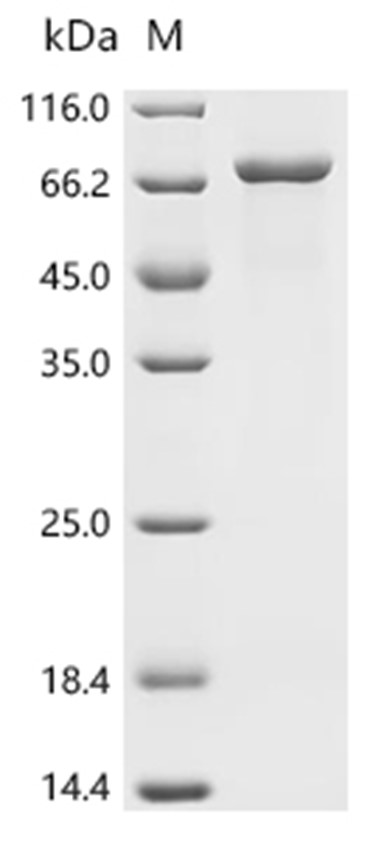 |
| Endotoxin | < 1.0 EU/μg of the protein as determined by the LAL method. |
| Formulation | Tris-based buffer, 50% glycerol |
| Reconstitution | Reconstitute the lyophilized protein in distilled water. The product concentration should not be less than 100 μg/ml. Before opening, centrifuge the tube to collect powder at the bottom. After adding the reconstitution buffer, avoid vortexing or pipetting for mixing. |
| Synonyms | Serine-protein kinase PCK1, Phosphoenolpyruvate carboxykinase, cytosolic [GTP], PEPCK-C, PEPCK1, PCK1, cytosolic [GTP] |
| Research Background | Cytosolic phosphoenolpyruvate carboxykinase that catalyzes the reversible decarboxylation and phosphorylation of oxaloacetate (OAA) and acts as the rate-limiting enzyme in gluconeogenesis. Regulates cataplerosis and anaplerosis, the processes that control the levels of metabolic intermediates in the citric acid cycle. At low glucose levels, it catalyzes the cataplerotic conversion of oxaloacetate to phosphoenolpyruvate (PEP), the rate-limiting step in the metabolic pathway that produces glucose from lactate and other precursors derived from the citric acid cycle. At high glucose levels, it catalyzes the anaplerotic conversion of phosphoenolpyruvate to oxaloacetate. Acts as a regulator of formation and maintenance of memory CD8(+) T-cells: up-regulated in these cells, where it generates phosphoenolpyruvate, via gluconeogenesis. The resultant phosphoenolpyruvate flows to glycogen and pentose phosphate pathway, which is essential for memory CD8(+) T-cells homeostasis. In addition to the phosphoenolpyruvate carboxykinase activity, also acts as a protein kinase when phosphorylated at Ser-90: phosphorylation at Ser-90 by AKT1 reduces the binding affinity to oxaloacetate and promotes an atypical serine protein kinase activity using GTP as donor. The protein kinase activity regulates lipogenesis: upon phosphorylation at Ser-90, translocates to the endoplasmic reticulum and catalyzes phosphorylation of INSIG proteins (INSIG1 and INSIG2), thereby disrupting the interaction between INSIG proteins and SCAP and promoting nuclear translocation of SREBP proteins (SREBF1/SREBP1 or SREBF2/SREBP2) and subsequent transcription of downstream lipogenesis-related genes. |
| Molecular Weight | 73.2 kDa (predicted) |
| Shipping | In general, lyophilized powders are shipped with blue ice, while solutions are shipped with dry ice. |
| Storage | Lyophilized powders can be stably stored for over 12 months, while liquid products can be stored for 6-12 months at -80°C. For reconstituted protein solutions, the solution can be stored at -20°C to -80°C for at least 3 months. Please avoid multiple freeze-thaw cycles and store products in aliquots. |
| Size | Quantity | Unit Price | Amount | Operation |
|---|
 Feedback
 Hello! How can I help you today?
Copyright © 2015-2026 TargetMol Chemicals Inc. All Rights Reserved.
