


Shopping Cart
Remove All Your shopping cart is currently empty
Synonyms: RP11-229P13.11-001, NTPDase-2, ectonucleoside triphosphate diphosphohydrolase 2, CD39L1
| Pack Size | Price | USA Stock | Global Stock | Quantity |
|---|---|---|---|---|
| 5 µg | $75 | - | In Stock | |
| 10 µg | $118 | - | In Stock | |
| 20 µg | $196 | - | In Stock | |
| 50 µg | $386 | - | In Stock | |
| 100 µg | $660 | 7-10 days | 7-10 days | |
| 200 µg | $1,120 | 7-10 days | 7-10 days | |
| 500 µg | $2,270 | 7-10 days | 7-10 days |
| Bioactivity | Measured by its ability to hydrolyze the 5’phosphate groups from the substrate adenosine 5’triphosphate(ATP). The specific activity is > 5,000 pmoles/min/μg. |
| Description | NTPDase 2, also known as ENTPD2, belongs to the ecto-nucleoside triphosphate diphosphohydrolase family (E-NTPDase). Members of E-NTPDase family are nucleotidases able to hydrolyze 5′-nucleoside tri- and/or diphosphates; the main role of these enzymes is the termination of purinergic signaling. NTPDases are ubiquitous and were previously shown in other parasites including the trypanosomatides of genus Leishmania and in T. brucei. NTPase activity would act as a timer and is crucial to T. gondii infection. In L. pneumophila it was demonstrated that an E-NTPDase, similar to CD39, is essential for intracellular bacterial multiplication. NTPDase 2 is an integral membrane protein. In the nervous system, it could hydrolyze ATP and other nucleotides to regulate purinergic neurotransmission. Alternative splicing of NTPDase 2 gene results in multiple transcript variants. |
| Species | Human |
| Expression System | Baculovirus Insect Cells |
| Tag | N-His |
| Accession Number | Q9Y5L3 |
| Construction | A DNA sequence encoding the mature form of human ENTPD2 (Q9Y5L3) (Thr29-Asp460) was expressed, with a polyhistidine tag at the N-terminus. Predicted N terminal: His |
| Protein Purity | > 85 % as determined by SDS-PAGE 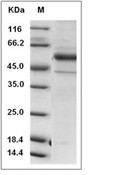 |
| Endotoxin | < 1.0 EU/μg of the protein as determined by the LAL method. |
| Formulation | Supplied as sterile 20 mM Tris, 500 mM NaCl, pH 7.4. |
| Reconstitution | A Certificate of Analysis (CoA) containing reconstitution instructions is included with the products. Please refer to the CoA for detailed information. |
| Synonyms | RP11-229P13.11-001, NTPDase-2, ectonucleoside triphosphate diphosphohydrolase 2, CD39L1 |
| Research Background | NTPDase 2, also known as ENTPD2, belongs to the ecto-nucleoside triphosphate diphosphohydrolase family (E-NTPDase). Members of E-NTPDase family are nucleotidases able to hydrolyze 5′-nucleoside tri- and/or diphosphates; the main role of these enzymes is the termination of purinergic signaling. NTPDases are ubiquitous and were previously shown in other parasites including the trypanosomatides of genus Leishmania and in T. brucei. NTPase activity would act as a timer and is crucial to T. gondii infection. In L. pneumophila it was demonstrated that an E-NTPDase, similar to CD39, is essential for intracellular bacterial multiplication. NTPDase 2 is an integral membrane protein. In the nervous system, it could hydrolyze ATP and other nucleotides to regulate purinergic neurotransmission. Alternative splicing of NTPDase 2 gene results in multiple transcript variants. |
| Molecular Weight | 49.3 kDa (predicted); 59 kDa (reducing conditions) |
| Shipping | Proteins are shipped with blue ice. |
| Storage | It is recommended to store the product under sterile conditions at -20°C to -80°C. Samples are stable for up to 12 months. Please avoid multiple freeze-thaw cycles and store products in aliquots. |
| Size | Quantity | Unit Price | Amount | Operation |
|---|
 Feedback
 Hello! How can I help you today?
Copyright © 2015-2026 TargetMol Chemicals Inc. All Rights Reserved.
