


Shopping Cart
Remove All Your shopping cart is currently empty
Synonyms: serpin peptidase inhibitor, clade G (C1 inhibitor), member 1
| Pack Size | Price | USA Stock | Global Stock | Quantity |
|---|---|---|---|---|
| 5 µg | $55 | - | In Stock | |
| 10 µg | $86 | - | In Stock | |
| 20 µg | $139 | - | In Stock | |
| 50 µg | $269 | - | In Stock | |
| 100 µg | $451 | - | In Stock | |
| 200 µg | $771 | 7-10 days | 7-10 days | |
| 500 µg | $1,560 | 7-10 days | 7-10 days |
| Bioactivity | Activity testing is in progress. It is theoretically active, but we cannot guarantee it. If you require protein activity, we recommend choosing the eukaryotic expression version first. |
| Description | C1 inhibitor Protein, Rat, Recombinant (His) is expressed in HEK293 mammalian cells with His tag. The predicted molecular weight is 54.7 kDa and the accession number is A6HMR4. |
| Species | Rat |
| Expression System | HEK293 Cells |
| Tag | C-His |
| Accession Number | A6HMR4 |
| Construction | A DNA sequence encoding the rat Serping1 (NP_954524.1) (Met1-Ala504) was expressed with a polyhistidine tag at the C-terminus. Predicted N terminal: Asp 23 |
| Protein Purity | > 95 % as determined by SDS-PAGE. 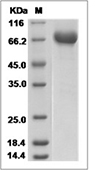 |
| Endotoxin | < 1.0 EU/μg of the protein as determined by the LAL method. |
| Formulation | Lyophilized from a solution filtered through a 0.22 μm filter, containing PBS, pH 7.4. Typically, a mixture containing 5% to 8% trehalose, mannitol, and 0.01% Tween 80 is incorporated as a protective agent before lyophilization. |
| Reconstitution | Reconstituted with sterile deionized water to 0.25 mg/mL. Reconstitution conditions may vary depending on the lot. |
| Synonyms | serpin peptidase inhibitor, clade G (C1 inhibitor), member 1 |
| Research Background | Plasma protease C1 inhibitor, also known as C1-inhibiting factor, C1-INH, C1 esterase inhibitor, SERPING1 and C1IN, is a serine proteinase inhibitor (serpin) that regulates activation of both the complement and contact systems. By its C-terminal part (serpin domain), characterized by three beta-sheets and an exposed mobile reactive loop, C1-INH binds, and blocks the activity of its target proteases. The N-terminal end (nonserpin domain) confers to C1-INH the capacity to bind lipopolysaccharides and E-selectin. Owing to this moiety, C1-INH intervenes in regulation of the inflammatory reaction. The heterozygous deficiency of C1-INH results in hereditary angioedema (HAE). Owing to its ability to modulate the contact and complement systems and the convincing safety profile, plasma-derived C1 inhibitor is an attractive therapeutic protein to treat inflammatory diseases other than HAE. Deficiency of C1 inhibitor results in hereditary angioedema, which is characterized by recurrent episodes of localized angioedema of the skin, gastrointestinal mucosa or upper respiratory mucosa. C1 inhibitor may prove useful in a variety of other diseases including septic shock, reperfusion injury, hyperacute transplant rejection, traumatic and hemorrhagic shock, and the increased vascular permeability associated with thermal injury, interleukin-2 therapy and cardiopulmonary bypass. |
| Molecular Weight | 54.7 kDa (predicted) |
| Shipping | In general, lyophilized powders are shipped with blue ice, while solutions are shipped with dry ice. |
| Storage | It is recommended to store recombinant proteins at -20°C to -80°C for future use. Lyophilized powders can be stably stored for over 12 months, while liquid products can be stored for 6-12 months at -80°C. For reconstituted protein solutions, the solution can be stored at -20°C to -80°C for at least 3 months. Please avoid multiple freeze-thaw cycles and store products in aliquots. |
| Size | Quantity | Unit Price | Amount | Operation |
|---|
 Feedback
 Hello! How can I help you today?
Copyright © 2015-2026 TargetMol Chemicals Inc. All Rights Reserved.
