


Shopping Cart
Remove All Your shopping cart is currently empty
Synonyms: CTNNB1, CTNNB, Catenin beta-1, Beta-catenin
| Pack Size | Price | USA Stock | Global Stock | Quantity |
|---|---|---|---|---|
| 20 µg | $987 | 35 days | 35 days |
| Bioactivity | Activity has not been tested. It is theoretically active, but we cannot guarantee it. |
| Description | Beta-Catenin Protein, Human, Recombinant (GST) is expressed in Baculovirus-Insect Cells. The accession number is P35222. |
| Species | Human |
| Expression System | Baculovirus-Insect Cells |
| Tag | N-GST |
| Accession Number | P35222 |
| Construction | Recombinant full length human Catenin beta was expressed by baculovirus in Sf9 insect cells using an N-terminal GST tag. |
| Protein Purity | >85% as determined by SDS-PAGE. 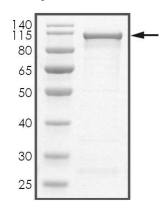 |
| Formulation | Supplied as sterile 50 mM Tris-HCl, pH 7.5, 150 mM NaCl, 10 mM glutathione, 0.1 mM EDTA, 0.25 mM DTT, 0.1 mM PMSF, 25% glycerol. |
| Synonyms | CTNNB1, CTNNB, Catenin beta-1, Beta-catenin |
| Research Background | beta-Catenin, also known as CTNNB1, is a member of the armadillo family of proteins. These proteins have multiple copies of the so-called armadillo repeat domain, which is specialized for protein-protein binding. It is part of a complex of proteins that constitute adherens junctions (AJs). AJs are necessary for the creation and maintenance of epithelial cell layers by regulating cell growth and adhesion between cells. CTNNB1 also anchors the actin cytoskeleton and may be responsible for transmitting the contact inhibition signal that causes cells to stop dividing once the epithelial sheet is complete. Finally, beta-Catenin binds to the product of the APC gene, which is mutated in adenomatous polyposis of the colon. Defects in beta-Catenin can cause colorectal cancer, pilomatrixoma (PTR), medulloblastoma, and ovarian cancer. CTNNB1 is a key dowstream component of the canonical Wnt signaling pathway. In the absence of Wnt, it forms a complex with AXIN1, AXIN2, APC, CSNK1A1 and GSK3B that promotes phosphorylation on N-terminal Ser and Thr residues and ubiquitination of CTNNB1 via BTRC and its subsequent degradation by the proteasome. In the presence of Wnt ligand, beta-Catenin is not ubiquitinated and accumulates in the nucleus, where it acts as a coactivator for transcription factors of the TCF/LEF family, leading to activate Wnt responsive genes. CTNNB1 is involved in the regulation of cell adhesion. The majority of beta-catenin is localized to the cell membrane and is part of E-cadherin/catenin adhesion complexes which are proposed to couple cadherins to the actin cytoskeleton. |
| Molecular Weight | ~115 kDa |
| Shipping | Enzymes are highly recommended to be shipped at frozen temperature with dry ice. Shipment made at ambient temperature may seriously affect the activity of the ordered products. |
| Storage | Lyophilized powders can be stably stored for over 12 months, while liquid products can be stored for 6-12 months at -80°C. For reconstituted protein solutions, the solution can be stored at -20°C to -80°C for at least 3 months. Please avoid multiple freeze-thaw cycles and store products in aliquots. |
| Size | Quantity | Unit Price | Amount | Operation |
|---|
 Feedback
 Hello! How can I help you today?
Copyright © 2015-2026 TargetMol Chemicals Inc. All Rights Reserved.
