


Shopping Cart
Remove All Your shopping cart is currently empty

Synonyms: p-HDAC4/5/9 (Ser246/259/220), p-HDAC4/5/9 (S246/259/220), HDAC4/5/9 (p-Ser246/259/220), HDAC4/5/9 (p-S246/259/220)
Anti-Phospho-HDAC4/5/9
(Ser246/259/220) Polyclonal Antibody
| Pack Size | Price | USA Stock | Global Stock | Quantity |
|---|---|---|---|---|
| 50 µL | $218 | 7-10 days | 7-10 days | |
| 100 µL | $317 | 7-10 days | 7-10 days |
| Description | Anti-Phospho-HDAC4/5/9 (Ser246/259/220) Polyclonal Antibody is a Rabbit antibody targeting Phospho-HDAC4/5/9 (Ser246/259/220). Anti-Phospho-HDAC4/5/9 (Ser246/259/220) Polyclonal Antibody can be used in IHC,WB. |
| Synonyms | p-HDAC4/5/9 (Ser246/259/220), p-HDAC4/5/9 (S246/259/220), HDAC4/5/9 (p-Ser246/259/220), HDAC4/5/9 (p-S246/259/220) |
| Ig Type | IgG |
| Reactivity | Human |
| Verified Activity | 1. Western blot analysis of extracts from 293 cells and Hela cells treated with serum using HDAC4/HDAC5/HDAC9 (phospho-Ser246/259/220) Antibody TMAC-01780. 2. Immunohistochemical analysis of paraffin-embedded human breast carcinoma tissue using HDAC4/HDAC5/HDAC9 (Phospho-Ser246/259/220) Antibody TMAC-01780 (left) or the same antibody preincubated with blocking peptide (right). 3. Western blot analysis of extracts from 293 cells untreated or treated with EGF using HDAC4/HDAC5/HDAC9 (phospho-Ser246/259/220) Antibody TMAC-01780. 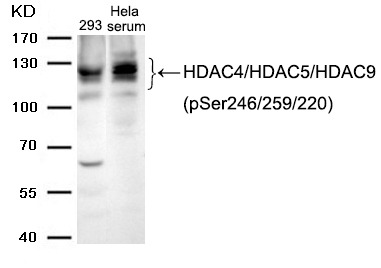 , ,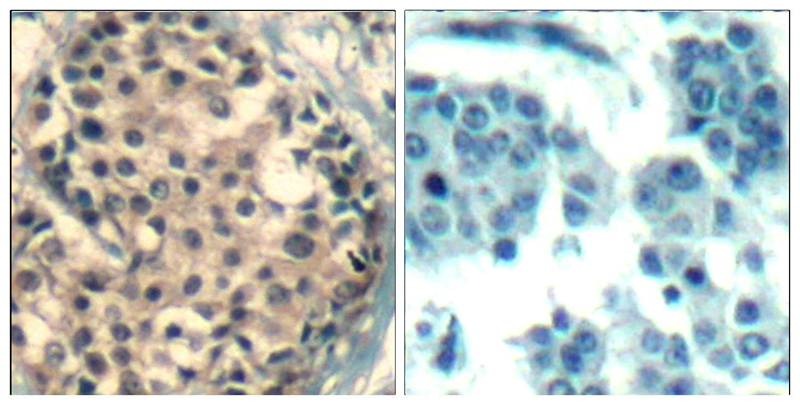 , ,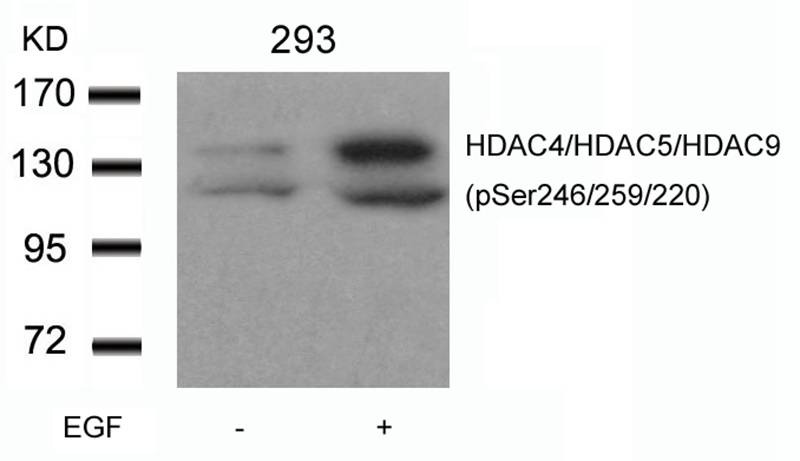 |
| Application | |
| Antibody Type | Polyclonal |
| Host Species | Rabbit |
| Construction | Polyclonal Antibody |
| Purification | Antibodies were produced by immunizing rabbits with synthetic phosphopeptide and KLH conjugates. Antibodies were purified by affinity-chromatography using epitope-specific phosphopeptide. Non-phospho specific antibodies were removed by chromatogramphy using non-phosphopeptide. |
| Appearance | Liquid |
| Formulation | Supplied at 1.0mg/mL in phosphate buffered saline (without Mg2+ and Ca2+), pH 7.4, 150mM NaCl, 0.02% sodium azide and 50% glycerol. |
| Research Background | Histone Deacetylases (HDACs) are a group of enzymes closely related to sirtuins. They catalyze the removal of acetyl groups from lysine residues in histones and non-histone proteins, resulting in transcriptional repression. In general,they do not act autonomously but as components of large multiprotein complexes, such as pRb-E2F and mSin3A, that mediate important transcription regulatory pathways. There are three classes of HDACs; classes 1, 2 and 4, which are closely related Zn2+-dependent enzymes. HDACs are ubiquitously expressed and they can exist in the nucleus or cytosol. Their subcellular localization is effected by protein-protein interactions (for example HDAC-14.3.3 complexes are retained in the cytosol) and by the class to which they belong (class 1 HDACs are predominantly nuclear whilst class 2 HDACs shuttle between the nucleus and cytosol). HDACs have a role in cell growth arrest, differentiation and death and this has led to substantial interest in HDAC inhibitors as possible antineoplastic agents. |
| Conjucates | Unconjugated |
| Others Formats | Phospho |
| Immunogen | Peptide sequence around phosphorylation site of serine 246/259/220 (T-A-S(p)-EP) derived from Human HDAC4/HDAC5/HDAC9 |
| Antigen Species | Human |
| Stability & Storage | Store at 2°C-8°C for 1 month. Store at -20°C or -80°C for 12 months. Avoid repeated freeze-thaw cycles. |
| Transport | Shipping with blue ice. |
| Size | Quantity | Unit Price | Amount | Operation |
|---|
 Feedback
 Hello! How can I help you today?
Copyright © 2015-2026 TargetMol Chemicals Inc. All Rights Reserved.
