


Shopping Cart
Remove All Your shopping cart is currently empty

Synonyms: LF, HLF2, HEL110, GIG12
Anti-LTF/Lactoferrin Polyclonal Antibody
| Pack Size | Price | USA Stock | Global Stock | Quantity |
|---|---|---|---|---|
| 50 µL | $222 | 7-10 days | 7-10 days | |
| 100 µL | $373 | 7-10 days | 7-10 days | |
| 200 µL | $528 | 7-10 days | 7-10 days |
| Description | Anti-LTF/Lactoferrin Polyclonal Antibody is a Rabbit antibody targeting LTF/Lactoferrin. Anti-LTF/Lactoferrin Polyclonal Antibody can be used in FCM,WB. |
| Synonyms | LF, HLF2, HEL110, GIG12 |
| Ig Type | IgG |
| Reactivity | Human (predicted:Mouse,Rat,Dog,Pig,Cow,Horse,Sheep) |
| Verified Activity | 1. Sample: Breast milk (Human) Lysate at 40 μg Primary: Anti-Lactoferrin (TMAB-01086) at 1/300 dilution Secondary: IRDye800CW Goat Anti-Rabbit IgG at 1/20000 dilution Predicted band size: 76 kDa Observed band size: 76 kDa 2. Blank control: U-937. Primary Antibody (green line): Rabbit Anti-Lactoferrin antibody (TMAB-01086) Dilution: 1 μg/Test; Secondary Antibody: Goat anti-rabbit IgG-FITC Dilution: 0.5 μg/Test. Protocol The cells were fixed with 4% PFA (10 min at room temperature) and then permeabilized with 0.1% PBST for 20 min at room temperature. The cells were then incubated in 5% BSA to block non-specific protein-protein interactions for 30 min at room temperature. Cells stained with Primary Antibody for 30 min at room temperature. The secondary antibody used for 40 min at room temperature. 3. U-937 cells were fixed with 4% PFA for 10 min at room temperature,permeabilized with 90% ice-cold methanol for 20 min at room temperature,and incubated in 5% BSA blocking buffer for 30 min at room temperature. Cells were then stained with Lactoferrin Antibody (TMAB-01086) at 1:500 dilution in blocking buffer and incubated for 30 min at room temperature, washed twice with 2% BSA in PBS, followed by secondary antibody incubation for 40 min at room temperature. Acquisitions of 20,000 events were performed. Cells stained with primary antibody (green), and isotype control (orange). 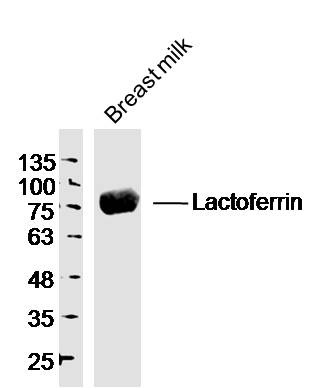 , ,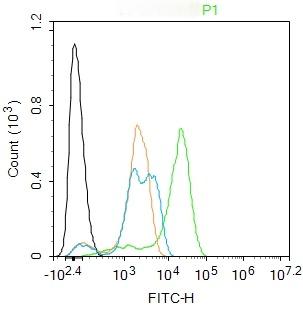 , ,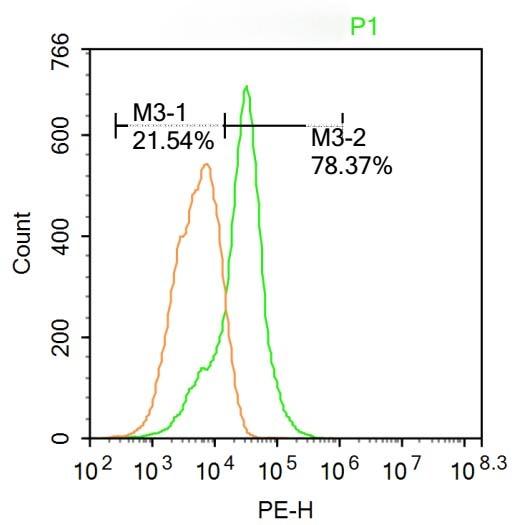 |
| Application | |
| Recommended Dose | WB: 1:500-2000; FCM: 1ug/test |
| Antibody Type | Polyclonal |
| Host Species | Rabbit |
| Subcellular Localization | Isoform 1: Secreted. Isoform DeltaLf: Cytoplasm. Nucleus. |
| Construction | Polyclonal Antibody |
| Purification | Protein A purified |
| Appearance | Liquid |
| Formulation | 0.01M TBS (pH7.4) with 1% BSA, 0.02% Proclin300 and 50% Glycerol. |
| Concentration | 1 mg/mL |
| Research Background | Transferrins are iron binding transport proteins which can bind two Fe(3+) ions in association with the binding of an anion, usually bicarbonate. Lactotransferrin has antimicrobial activity which depends on the extracellular cation concentration. Lactoferroxins A, B and C have opioid antagonist activity. Lactoferroxin A shows preference for mu-receptors, while lactoferroxin B and C have somewhat higher degrees of preference for kappa-receptors than for mu-receptors. The lactotransferrin transferrin-like domain 1 functions as a serine protease of the peptidase S60 family that cuts arginine rich regions. This function contributes to the antimicrobial activity. |
| Immunogen | KLH conjugated synthetic peptide: human Lactoferrin |
| Antigen Species | Human |
| Gene Name | LTF |
| Gene ID | |
| Protein Name | Lactotransferrin |
| Uniprot ID | |
| Biology Area | Apoptosis,Apoptosis,Serum Proteins |
| Function | Transferrins are iron binding transport proteins which can bind two Fe(3+) ions in association with the binding of an anion, usually bicarbonate. Lactotransferrin has antimicrobial activity which depends on the extracellular cation concentration. Lactoferroxins A, B and C have opioid antagonist activity. Lactoferroxin A shows preference for mu-receptors, while lactoferroxin B and C have somewhat higher degrees of preference for kappa-receptors than for mu-receptors. The lactotransferrin transferrin-like domain 1 functions as a serine protease of the peptidase S60 family that cuts arginine rich regions. This function contributes to the antimicrobial activity. Isoform DeltaLf: transcription factor with antiproliferative properties and inducing cell cycle arrest. Binds to DeltaLf response element found in the SKP1, BAX, DCPS, and SELH promoters.extracellular cation concentration. |
| Molecular Weight | Theoretical: 76 kDa. Actual: 76 kDa. |
| Stability & Storage | Store at -20°C or -80°C for 12 months. Avoid repeated freeze-thaw cycles. |
| Transport | Shipping with blue ice. |
| Size | Quantity | Unit Price | Amount | Operation |
|---|
 Feedback
 Hello! How can I help you today?
Copyright © 2015-2026 TargetMol Chemicals Inc. All Rights Reserved.
