


Shopping Cart
Remove All Your shopping cart is currently empty

Synonyms: rHM74b, Puma-g, PUMAG, Puma g, Protein PUMA-G, Nicotinic acid receptor 1, Nicotinic acid receptor, Niacr1, Niacin receptor 1, Interferon gamma inducible gene Puma g, HM74b, HM74a, HCAR2, G-protein coupled receptor HM74, G-protein coupled receptor 109A, G-protein coupled receptor 109, GPR109A, G protein coupled receptor Hm74b, G protein coupled receptor HM74a
Anti-GPR109A Polyclonal Antibody
| Pack Size | Price | USA Stock | Global Stock | Quantity |
|---|---|---|---|---|
| 50 µL | $222 | 7-10 days | 7-10 days | |
| 100 µL | $374 | 7-10 days | 7-10 days | |
| 200 µL | $528 | 7-10 days | 7-10 days |
| Description | Anti-GPR109A Polyclonal Antibody is a Rabbit antibody targeting GPR109A. Anti-GPR109A Polyclonal Antibody can be used in WB. |
| Synonyms | rHM74b, Puma-g, PUMAG, Puma g, Protein PUMA-G, Nicotinic acid receptor 1, Nicotinic acid receptor, Niacr1, Niacin receptor 1, Interferon gamma inducible gene Puma g, HM74b, HM74a, HCAR2, G-protein coupled receptor HM74, G-protein coupled receptor 109A, G-protein coupled receptor 109, GPR109A, G protein coupled receptor Hm74b, G protein coupled receptor HM74a |
| Ig Type | IgG |
| Reactivity | Human,Mouse (predicted:Rat,Cow,Rabbit) |
| Verified Activity | Sample: Skin (Mouse) Lysate at 40 μg Primary: Anti-GPR109R (TMAB-00787) at 1/300 dilution Secondary: IRDye800CW Goat Anti-Rabbit IgG at 1/20000 dilution Predicted band size: 40 kDa Observed band size: 40 kDa 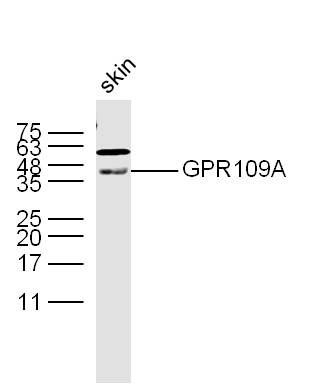 |
| Application | |
| Recommended Dose | WB: 1:500-2000 |
| Antibody Type | Polyclonal |
| Host Species | Rabbit |
| Subcellular Localization | Cell membrane; Multi-pass membrane protein. |
| Tissue Specificity | Expression largely restricted to adipose tissue and spleen. Expressed on mature neutrophils but not on immature neutrophils or eosinophils. |
| Construction | Polyclonal Antibody |
| Purification | Protein A purified |
| Appearance | Liquid |
| Formulation | 0.01M TBS (pH7.4) with 1% BSA, 0.02% Proclin300 and 50% Glycerol. |
| Concentration | 1 mg/mL |
| Research Background | Acts as a high affinity receptor for both nicotinic acid (also known as niacin) and (D)-beta-hydroxybutyrate and mediates increased adiponectin secretion and decreased lipolysis through G(i)-protein-mediated inhibition of adenylyl cyclase. This pharmacological effect requires nicotinic acid doses that are much higher than those provided by a normal diet. Mediates nicotinic acid-induced apoptosis in mature neutrophils. Receptor activation by nicotinic acid results in reduced cAMP levels which may affect activity of cAMP-dependent protein kinase A and phosphorylation of target proteins, leading to neutrophil apoptosis. |
| Immunogen | KLH conjugated synthetic peptide: human GPR109A/HM74A |
| Antigen Species | Human |
| Gene Name | HCAR2 |
| Gene ID | |
| Protein Name | Hydroxycarboxylic acid receptor 2 |
| Uniprot ID | |
| Biology Area | Hydrolysis,p53 Pathway,Hydrolysis,Cancer,GPCR |
| Function | Acts as a high affinity receptor for both nicotinic acid (also known as niacin) and (D)-beta-hydroxybutyrate and mediates increased adiponectin secretion and decreased lipolysis through G(i)-protein-mediated inhibition of adenylyl cyclase. This pharmacological effect requires nicotinic acid doses that are much higher than those provided by a normal diet. Mediates nicotinic acid-induced apoptosis in mature neutrophils. Receptor activation by nicotinic acid results in reduced cAMP levels which may affect activity of cAMP-dependent protein kinase A and phosphorylation of target proteins, leading to neutrophil apoptosis. The rank order of potency for the displacement of nicotinic acid binding is 5-methyl pyrazole-3-carboxylic acid = pyridine-3-acetic acid > acifran > 5-methyl nicotinic acid = acipimox >> nicotinuric acid = nicotinamide. |
| Molecular Weight | Theoretical: 40 kDa. Actual: 40 kDa. |
| Stability & Storage | Store at -20°C or -80°C for 12 months. Avoid repeated freeze-thaw cycles. |
| Transport | Shipping with blue ice. |
| Size | Quantity | Unit Price | Amount | Operation |
|---|
 Feedback
 Hello! How can I help you today?
Copyright © 2015-2026 TargetMol Chemicals Inc. All Rights Reserved.
