


Shopping Cart
Remove All Your shopping cart is currently empty

Synonyms: Type 2 angiotensin II receptor, MRX88, MRX 88, ATGR2, ATGR 2, AT2R2, AT2, AT 2, Angiotensin receptor 2, Angiotensin II type-2 receptor, Angiotensin II Type 2, angiotensin II receptor type 2, AGTR2, AGTR 2
Anti-AT2R2 Polyclonal Antibody
| Pack Size | Price | USA Stock | Global Stock | Quantity |
|---|---|---|---|---|
| 50 µL | $220 | 7-10 days | 7-10 days | |
| 100 µL | $372 | 7-10 days | 7-10 days | |
| 200 µL | $529 | 7-10 days | 7-10 days |
| Description | Anti-AT2R2 Polyclonal Antibody is a Rabbit antibody targeting AT2R2. Anti-AT2R2 Polyclonal Antibody can be used in WB. |
| Synonyms | Type 2 angiotensin II receptor, MRX88, MRX 88, ATGR2, ATGR 2, AT2R2, AT2, AT 2, Angiotensin receptor 2, Angiotensin II type-2 receptor, Angiotensin II Type 2, angiotensin II receptor type 2, AGTR2, AGTR 2 |
| Ig Type | IgG |
| Reactivity | Mouse,Rat (predicted:Human,Dog,Pig,Horse,Sheep) |
| Verified Activity | Sample: Lane 1: Mouse Uterus tissue lysates Lane 2: Mouse Liver tissue lysates Lane 3: Rat Uterus tissue lysates Primary: Anti-AT2R2 (TMAB-00156) at 1/1000 dilution Secondary: IRDye800CW Goat Anti-Rabbit IgG at 1/20000 dilution Predicted band size: 41 kDa Observed band size: 50 kDa 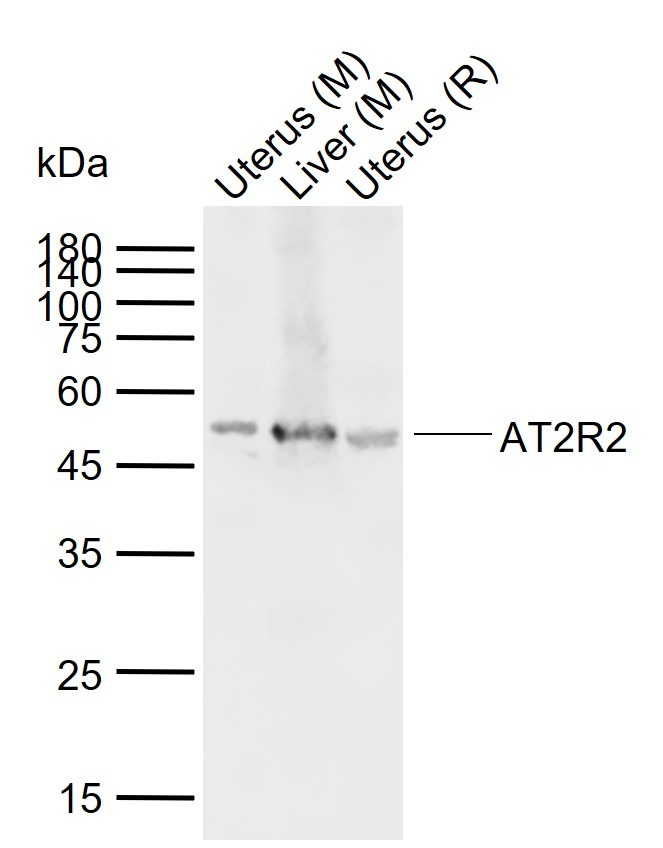 |
| Application | |
| Recommended Dose | WB: 1:500-2000 |
| Antibody Type | Polyclonal |
| Host Species | Rabbit |
| Subcellular Localization | Cell membrane. |
| Tissue Specificity | In adult, highly expressed in myometrium with lower levels in adrenal gland and fallopian tube. Very highly expressed in fetal kidney and intestine. |
| Construction | Polyclonal Antibody |
| Purification | Protein A purified |
| Appearance | Liquid |
| Formulation | 0.01M TBS (pH7.4) with 1% BSA, 0.02% Proclin300 and 50% Glycerol. |
| Concentration | 1 mg/mL |
| Research Background | Angiotensin II (Ang II) is an important physiological effector of blood pressure and volume regulation through vasoconstriction, aldosterone release, sodium uptake and thirst stimulation. Although Ang II interacts with two types of cell surface receptors, AT1 and AT2, most of the major cardiovascular effects seem to be mediated through AT1. Molecular cloning of the AT1 protein has shown it to be a member of the G protein-associated seven transmembrane protein receptor family. Ang II treatment of cells results in activation of several signal transduction pathways as evidenced by tyrosine phosphorylation of several proteins and induction of others. PLC?is phosphorylated after 30 seconds of treatment with Angiotensin II, indicating this as an early signal transduction event. Ang II treatment also stimulates phosphorylation of Shc, FAK and MAP kinases, and induces MKP-1, indicating stimulation of growth factor pathways. Ang II stimulation through AT1 has been shown to activate the JAK/Stat pathway involving a direct interaction between JAK2 and AT1 as demonstrated by coimmunoprecipitation. The AT1 receptor has no cytoplasmic kinase domain, but is able to function as a substrate for Src kinases and has several putative phosphorylation sites. |
| Immunogen | KLH conjugated synthetic peptide: human angiotensin II receptor type 2 |
| Antigen Species | Human |
| Gene Name | AGTR2 |
| Gene ID | |
| Protein Name | Type-2 angiotensin II receptor |
| Uniprot ID | |
| Biology Area | Apoptosis,Blood Pressure regulation,GPCR,PLC |
| Function | Receptor for angiotensin II. Cooperates with MTUS1 to inhibit ERK2 activation and cell proliferation. |
| Molecular Weight | Theoretical: 41 kDa. Actual: 50 kDa. |
| Stability & Storage | Store at -20°C or -80°C for 12 months. Avoid repeated freeze-thaw cycles. |
| Transport | Shipping with blue ice. |
| Size | Quantity | Unit Price | Amount | Operation |
|---|
 Feedback
 Hello! How can I help you today?
Copyright © 2015-2026 TargetMol Chemicals Inc. All Rights Reserved.
