


Shopping Cart
Remove All Your shopping cart is currently empty

Synonyms: msr/apj, MSR, MGC45246, HG11, HG 11, GPCR34, G protein coupled receptor APJ, FLJ96609, FLJ90771, B78, Aplnr, APJ receptor, APJ, Apelin receptor, Angiotensin receptor like 1, Angiotensin II receptor like 1, AGTRL1, AGTRL 1, AGTR L1
Anti-Apelin Receptor Polyclonal Antibody
| Pack Size | Price | USA Stock | Global Stock | Quantity |
|---|---|---|---|---|
| 50 µL | $221 | 7-10 days | 7-10 days | |
| 100 µL | $373 | 7-10 days | 7-10 days | |
| 200 µL | $529 | 7-10 days | 7-10 days |
| Description | Anti-Apelin Receptor Polyclonal Antibody is a Rabbit antibody targeting Apelin Receptor. Anti-Apelin Receptor Polyclonal Antibody can be used in WB. |
| Synonyms | msr/apj, MSR, MGC45246, HG11, HG 11, GPCR34, G protein coupled receptor APJ, FLJ96609, FLJ90771, B78, Aplnr, APJ receptor, APJ, Apelin receptor, Angiotensin receptor like 1, Angiotensin II receptor like 1, AGTRL1, AGTRL 1, AGTR L1 |
| Ig Type | IgG |
| Reactivity | Mouse (predicted:Human,Rat,Dog,Rabbit,Chicken,Horse) |
| Verified Activity | 25 μg total protein per Lane of various lysates probed with Apelin Receptor polyclonal antibody, unconjugated (TMAB-00128) at 1:1000 dilution and 4°C overnight incubation. Followed by conjugated secondary antibody incubation at RT for 60 min. 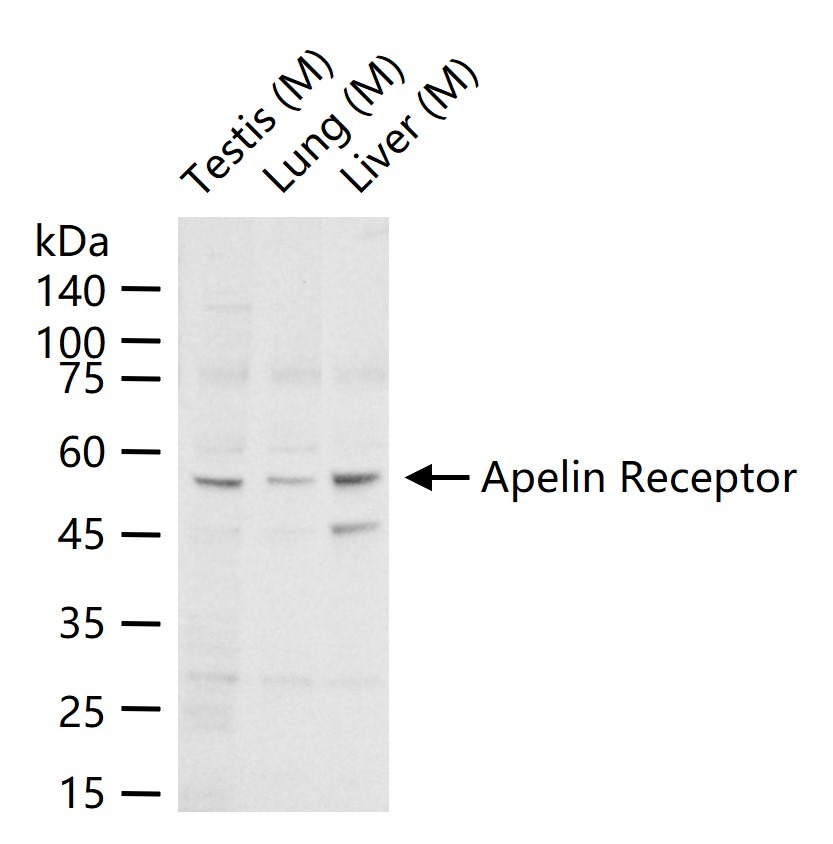 |
| Application | |
| Recommended Dose | WB: 1:500-2000 |
| Antibody Type | Polyclonal |
| Host Species | Rabbit |
| Subcellular Localization | Cell membrane. |
| Tissue Specificity | Widely expressed in the brain, in glial cells, astrocytes and neuronal subpopulations, as well as in the spleen, thymus, ovary, small intestine and colon. |
| Construction | Polyclonal Antibody |
| Purification | Protein A purified |
| Appearance | Liquid |
| Formulation | 0.01M TBS (pH7.4) with 1% BSA, 0.02% Proclin300 and 50% Glycerol. |
| Concentration | 1 mg/mL |
| Research Background | This gene encodes a member of the G protein-coupled receptor gene family. The encoded protein is related to the angiotensin receptor, but is actually an apelin receptor that inhibits adenylate cyclase activity and plays a counter-regulatory role against the pressure action of angiotensin II by exerting hypertensive effect. It functions in the cardiovascular and central nervous systems, in glucose metabolism, in embryonic and tumor angiogenesis and as a human immunodeficiency virus (HIV-1) coreceptor. Two transcript variants resulting from alternative splicing have been identified. [provided by RefSeq |
| Immunogen | KLH conjugated synthetic peptide: human Apelin receptor |
| Antigen Species | Human |
| Gene Name | APLNR |
| Gene ID | |
| Protein Name | Apelin receptor |
| Uniprot ID | |
| Function | Receptor for apelin coupled to G proteins that inhibit adenylate cyclase activity. Alternative coreceptor with CD4 for HIV-1 infection; may be involved in the development of AIDS dementia. |
| Molecular Weight | Theoretical: 42 kDa. Actual: 52 kDa. |
| Stability & Storage | Store at -20°C or -80°C for 12 months. Avoid repeated freeze-thaw cycles. |
| Transport | Shipping with blue ice. |
| Size | Quantity | Unit Price | Amount | Operation |
|---|
 Feedback
 Hello! How can I help you today?
Copyright © 2015-2026 TargetMol Chemicals Inc. All Rights Reserved.
