


Shopping Cart
Remove All Your shopping cart is currently empty

Synonyms: Acetyl-Coenzyme A carboxylase alpha (ACC-alpha), Acetyl-CoA carboxylase 1, ACC1, ACACA, ACAC
Anti-ACACA Antibody
(2D514)
| Pack Size | Price | USA Stock | Global Stock | Quantity |
|---|---|---|---|---|
| 50 µL | $298 | 7-10 days | 7-10 days | |
| 100 µL | $427 | 7-10 days | 7-10 days |
| Description | Anti-ACACA Antibody (2D514) is a Mouse antibody targeting ACACA. Anti-ACACA Antibody (2D514) can be used in IF,IP,WB. |
| Synonyms | Acetyl-Coenzyme A carboxylase alpha (ACC-alpha), Acetyl-CoA carboxylase 1, ACC1, ACACA, ACAC |
| Clone | 2D514 |
| Reactivity | Human |
| Verified Activity | 1. Western blot analysis of ACCα expression in DU 145 (A) and Jurkat (B) whole cell lysates. 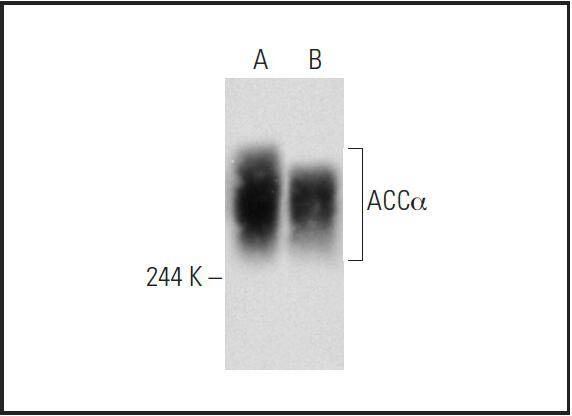 |
| Application | |
| Recommended Dose | WB: 1:100-1000; IP: 1-2 μg per 100-500 μg of total protein |
| Antibody Type | Monoclonal |
| Host Species | Mouse |
| Construction | Hybridoma Monoclonal Antibody |
| Purification | ProA affinity purified |
| Appearance | Liquid |
| Formulation | 1*TBS (pH7.4), 1%BSA, 40%Glycerol. Preservative: 0.05% Sodium Azide. |
| Research Background | Acetyl-CoA carboxylase (ACC) is a complex multifunctional enzyme system which catalyzes the carboxylation of acetyl-CoA to malonyl-CoA, the rate-limiting step in fatty acid synthesis. Exercise diminishes the activity of acetyl-CoA carboxylase in human muscle. ACCα (ACC1) is the rate-limiting enzyme in the biogenesis of long-chain fatty acids, and ACCβ (ACC2) may control mitochondrial fatty acid oxidation. These two isoforms of ACC control the amount of fatty acids in the cells. The catalytic function of ACCα is regulated by phosphorylation (inactive) and dephosphorylation (active) of targeted serine residues and by allosteric transformation by citrate or palmitoyl-CoA, which serve as the enzyme’s short-term regulatory mechanism. The gene encoding ACCα maps to human chromosome 17 and encodes a form of ACC, which is the major ACC in lipogenic tissues. The catalytic core of ACCβ is homologous to that of the ACCα, except for an additional peptide of about 150 amino acids at the N-terminus. |
| Conjucates | Unconjugated |
| Immunogen | Peptide |
| Uniprot ID |
| Molecular Weight | Theoretical: 265 kDa. |
| Stability & Storage | Store at -20°C or -80°C for 12 months. Avoid repeated freeze-thaw cycles. |
| Transport | Shipping with blue ice. |
| Size | Quantity | Unit Price | Amount | Operation |
|---|
 Feedback
 Hello! How can I help you today?
Copyright © 2015-2026 TargetMol Chemicals Inc. All Rights Reserved.
